
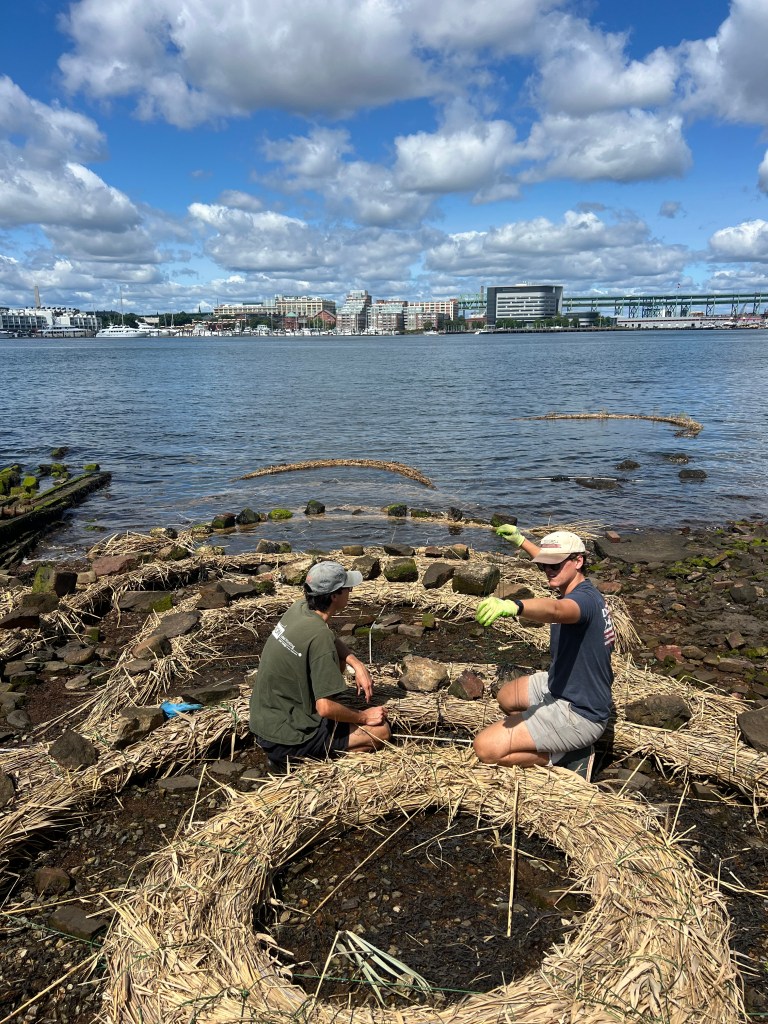
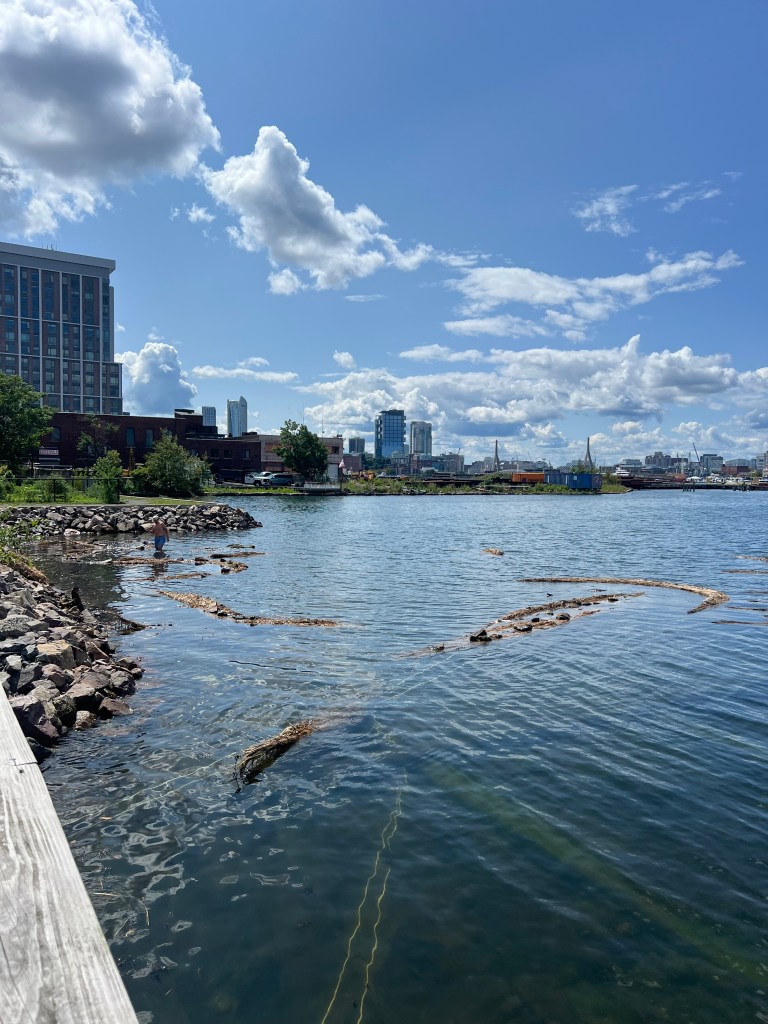
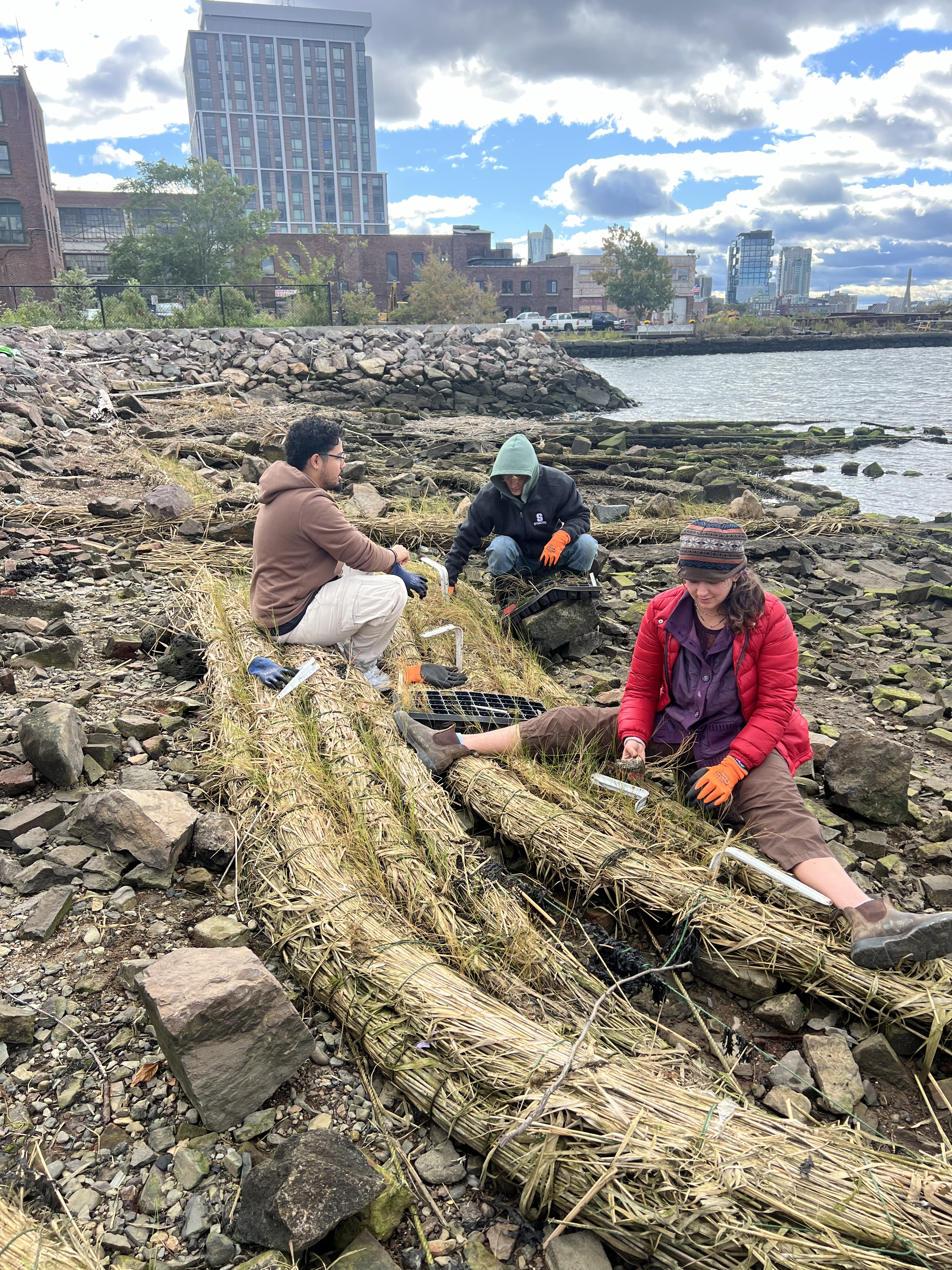
At 102 Border Street lies a post-industrial rocky intertidal beach with abandoned pilings, boat launch rails, wooden railroad ties, bricks, rocky conglomerates, and rusted metal left in place from its days as the largest railway, ship repair and launch site in Boston. The beach is exposed to moderate Boston inner harbor waves and weather. After obtaining a permit from the City of Boston’s Conservation Commission, we began surveying the debris and topography, and building prototypes of various shapes, sizes, and styles to align with this landscape. One by one, we deployed over 15 prototypes with biomass-based substrates and planted living Spartina alterniflora and Spartina patens into them on site.
Site Description
102 Border Street is a parcel of undeveloped land with a flat upland area abutting a harborwalk at the water’s edge. Below the riprap that supports the walkway there is a rocky intertidal beach with extensive relics of the site’s post-industrial past. The parcel is in a Designated Port Area, and the property boundaries extend out about 500 feet offshore—about ¾ of the site is underwater at high tide.
Prototypes
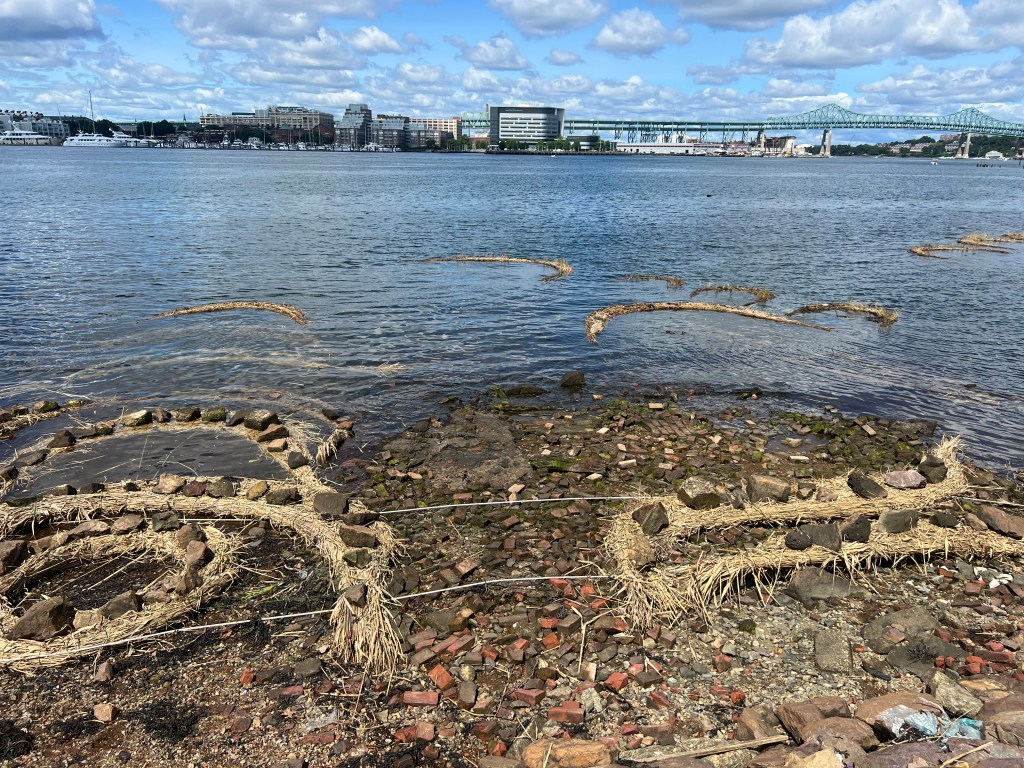
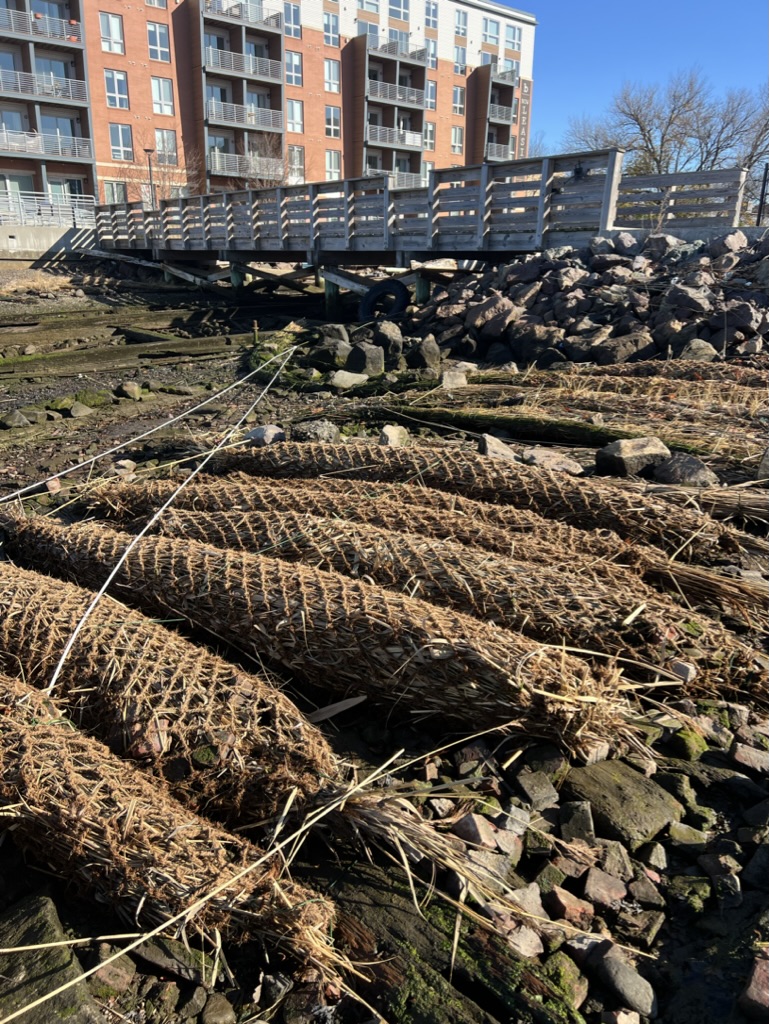
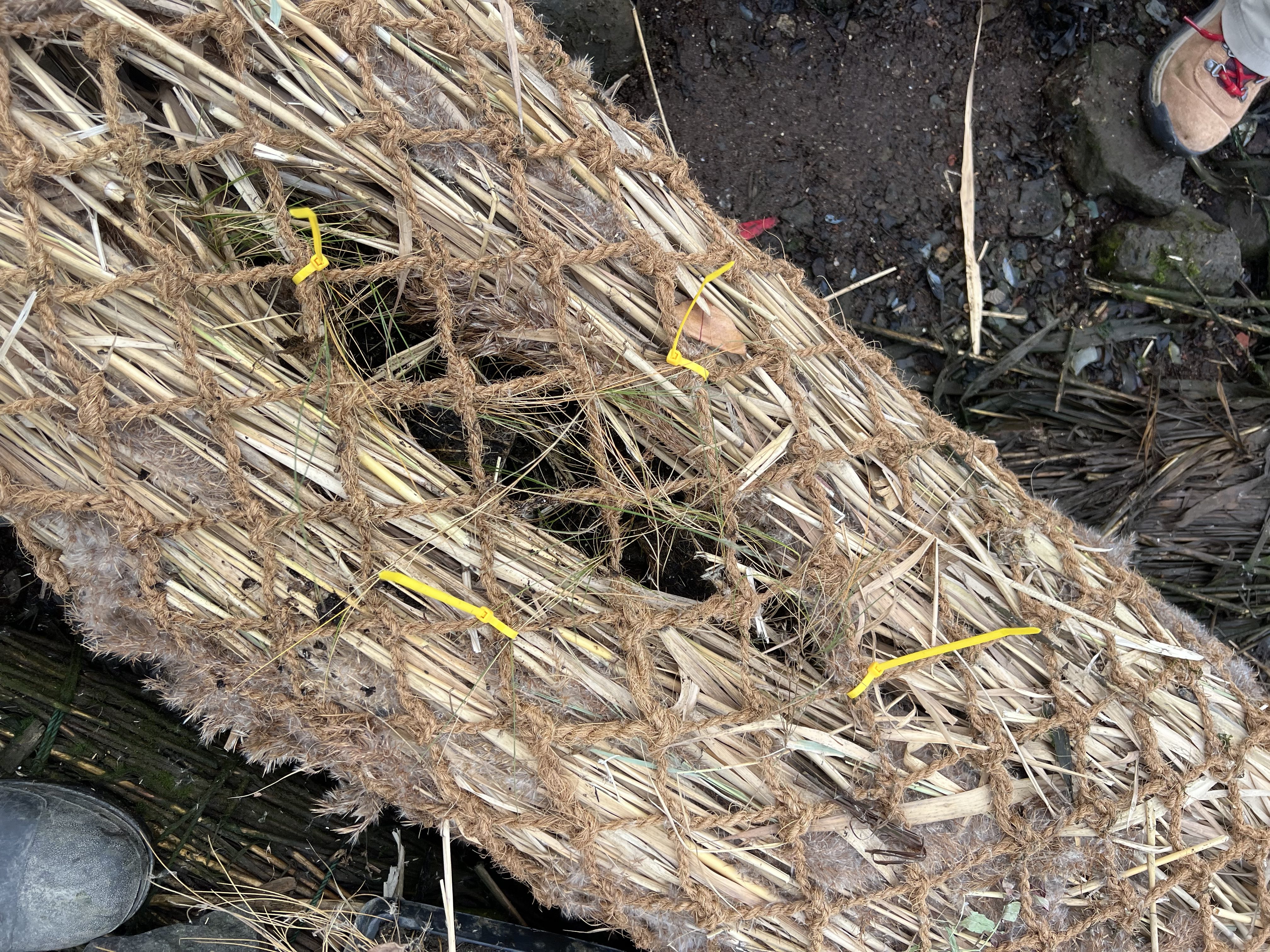
Living shoreline prototypes of the Lashed Bundle and Stuffed Net Tube types were deployed at Border Street. Different shapes and configurations of Lashed Bundle prototypes were designed to contour around the irregular landscape features.
Additionally, some of the floating wetland prototypes initially deployed in the Piers Park floating frame were towed over to this site and had their foam floatation removed, after about 12 months in the water. Since we are studying the saturation of the biomass living shoreline prototypes over time, we were curious if pre-saturated units would perform better than newly-harvested biomass as a substrate for Spartina.
Check out this article in the Bay State Banner that documents our efforts at 102 Border St.
Monitoring
In collaboration with scientists from Northeastern University’s Hughes Lab for Marine Biodiversity and Conservation, and with the help of our teams of Climate Corps trainees, we monitored each prototype qualitatively and quantitatively, to record our observations of the prototypes in a systematic manner.
Monitoring involved observing percent cover of algae, counting the number of plugs inside the units, measuring maximum length of Spartina grass blades, and noting any other changes. Monitoring is ongoing, in order to see how the prototypes fare throughout changing seasons and multiple years.
Successes & Failures
Successes:
- Having a permitted deployment site located under a mile from our assembly yard was a huge success, enabling us to build and deploy prolifically throughout 2024.
- The large intertidal beach area at Border Street provides abundant space for prototypes of many kinds to coexist, ranging from those dedicated to particular experiments of our collaborative research with Hughes Lab and many other separate prototypes and oddball tests.
- The abundance of structures throughout and surrounding the site allowed us to try many anchoring strategies, ranging from staking down to the sediment to affixing to a web of ropes to using rocks and bricks as ballast.
- The adjacent residential building and harborwalk ensures that there are many passers-by and curious observers, helping the community to be aware of our work. Sharing our process in real time was a great way to spread knowledge about coastal resilience, marsh restoration, and the effects of climate change in the neighborhood.
Failures:
- Ocean trash, or flotsam, often drifts onto the site since it is so exposed to the inner harbor, and tends to get caught in our prototypes or in the adjacent riprap.
- The predominantly rocky sediment made it difficult to secure prototypes down using stakes. In some places, rocks prevented stakes from going in, and in other places, muck under the rocky surface was too loose to hold at all.
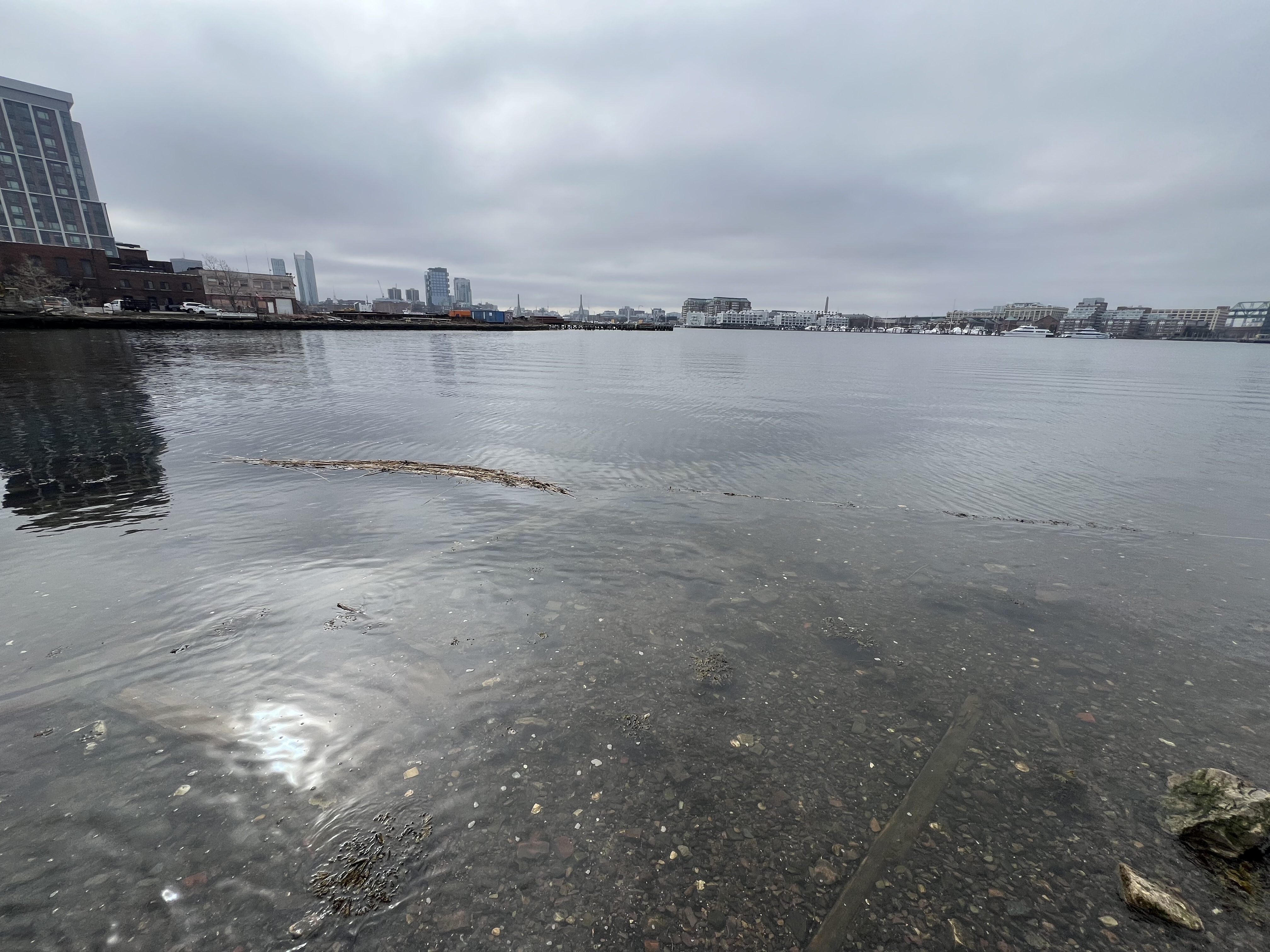
- Over the winter, the prototypes that were lowest in elevation, broke apart and in some cases, disappeared and left only the nylon string. These prototypes were highly exposed to the waves, tides, and large ocean trash.

 emerald-tutu.com