
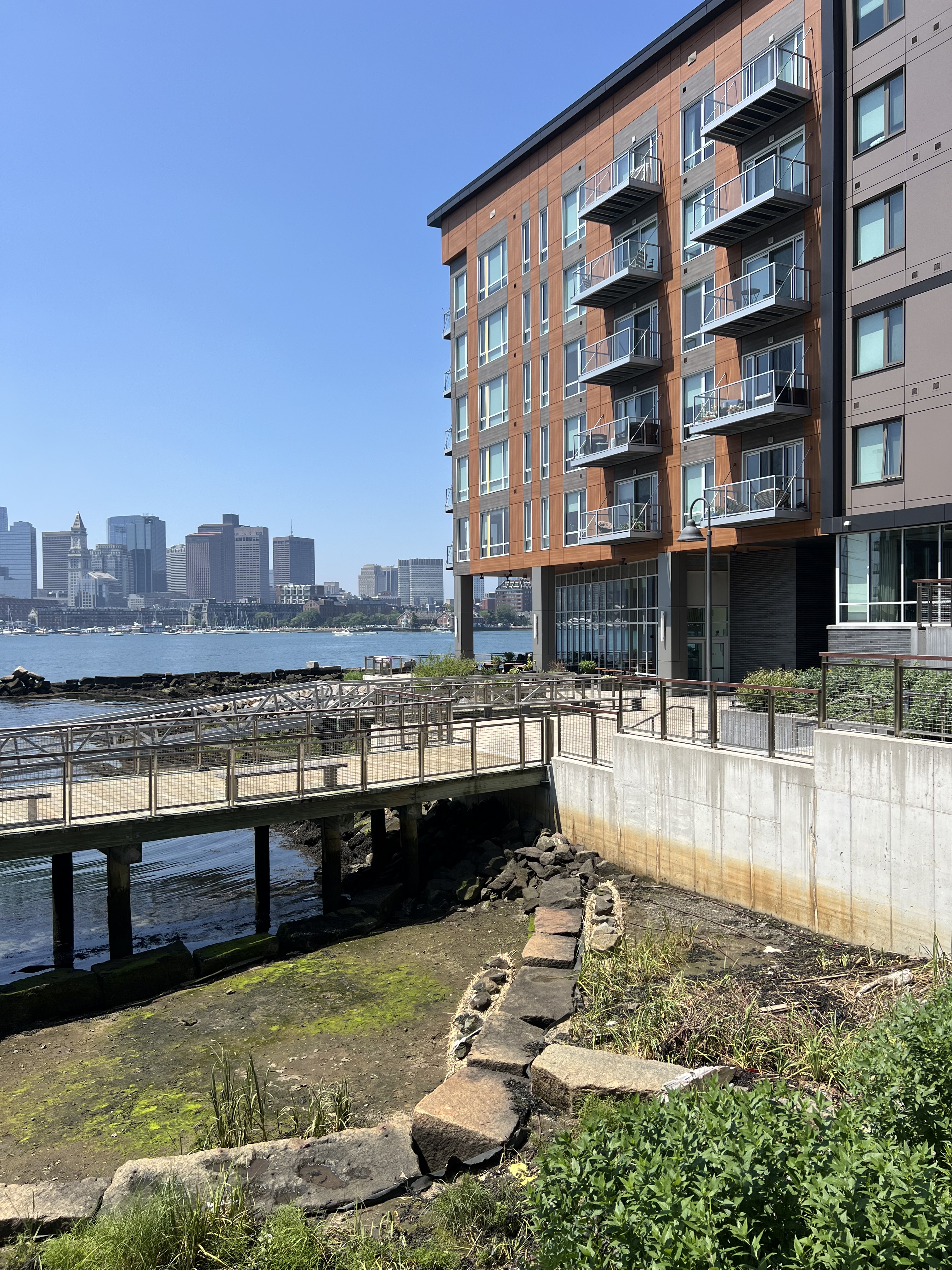
The Eastie waterfront residential development, Clippership Wharf, has the best view of the Boston skyline with a constructed living shoreline reaching out into the Boston Harbor. The living shoreline helps protects against coastal flooding, sea level rise, and storm surge. It restores the area to salt marsh and tideland ecosystems while providing habitat to native species. The shoreline is exposed to moderate Boston inner harbor waves and weather. During the summer of 2025, The Emerald Tutu deployed 5 living shoreline prototypes at different elevations to experiment with re-growing Spartina alterniflora.

Site Description
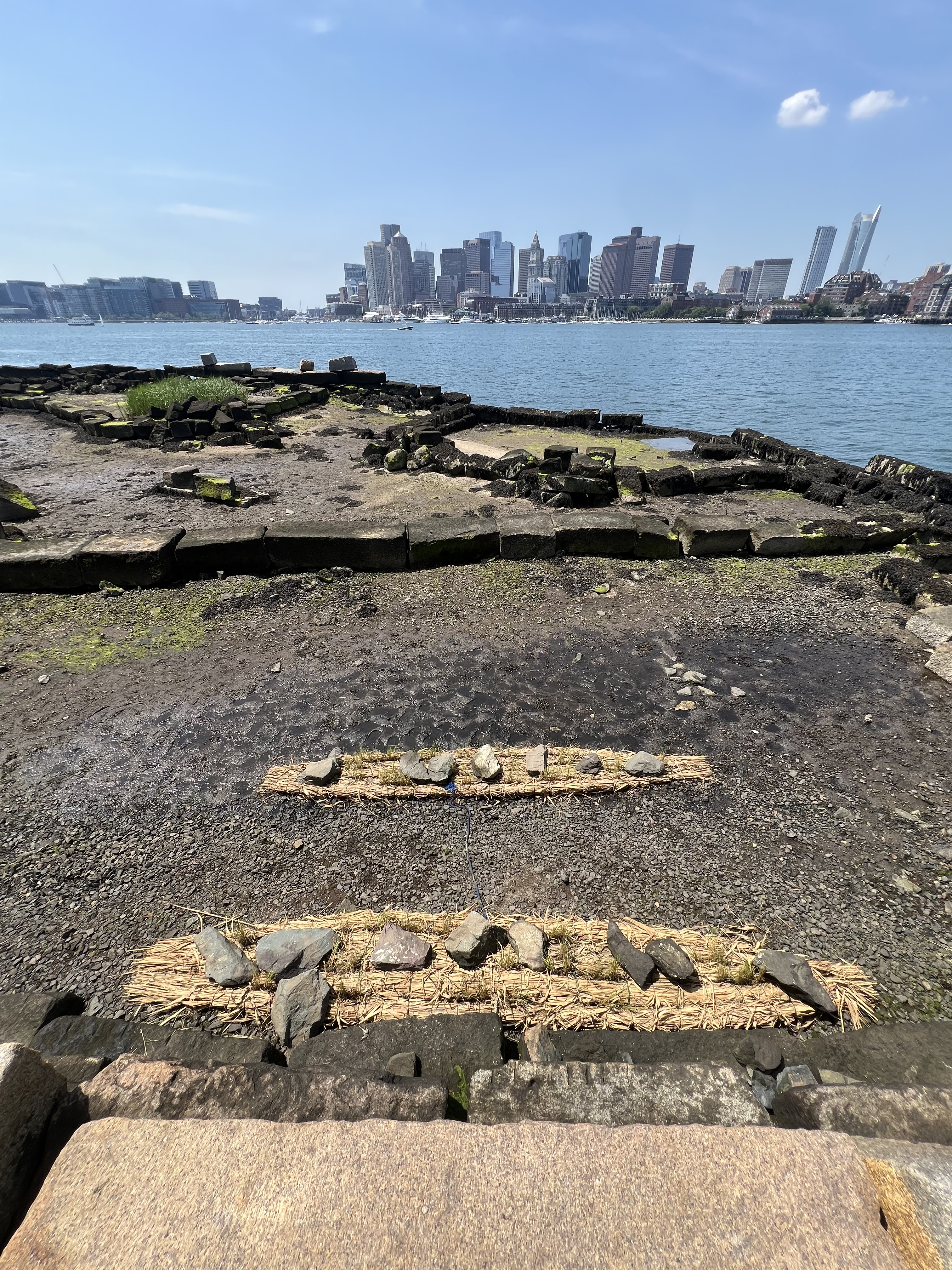
Clippership Wharf Living Shoreline is made of various terraces and sections that allows water to flow in and out with the tides. Seaweed and algae are growing on the outer seawall that protects the residential building and living shoreline from strong wave action. The lower levels are mudflat ecosystems with hermit crabs and barnacles. The higher terraces have elevation levels that allow for vegetation to grow thickly and healthily in some sections. In the sections where plants are absent, The Emerald Tutu is pursuing this re-growing experiment.
Prototypes

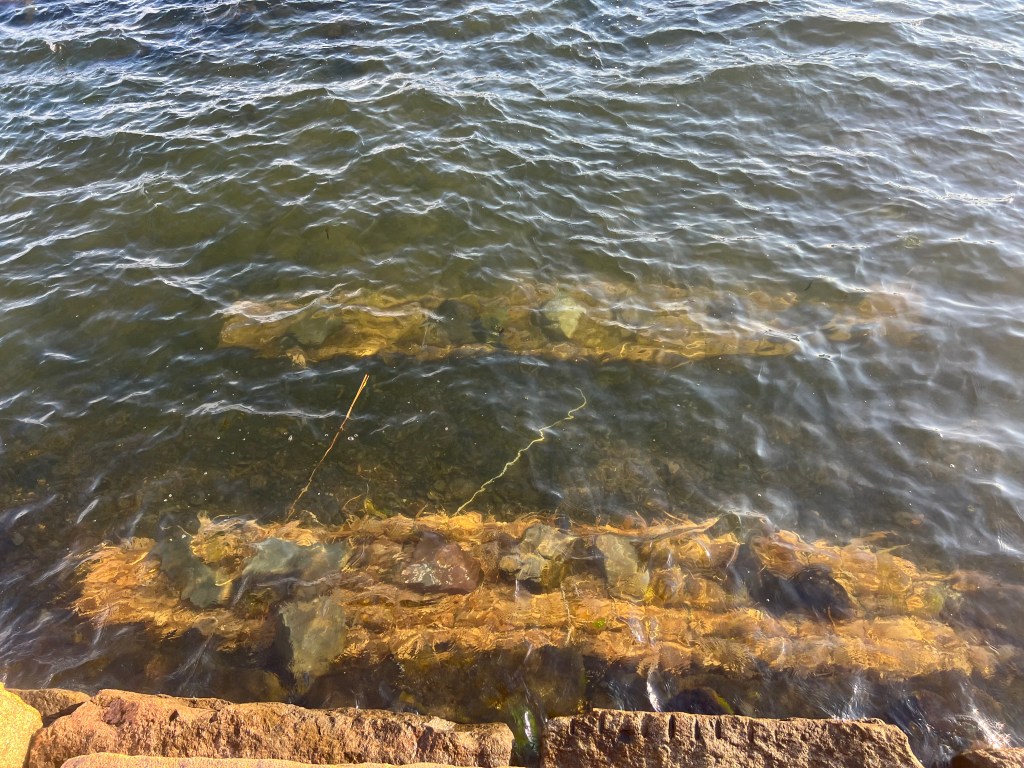
Living shoreline prototypes of the canoe-shaped Lashed Bundles were deployed at Clippership Wharf. The 5 prototype locations were selected based on elevation, proximity to other vegetation, and spacial variability. The prototypes are tied to existing anchor points, secured with metal stakes, and weighed down by heavy rocks from the site. Spartina alterniflora plugs were planted into the bundles.
Monitoring
Monitoring involved counting Spartina alterniflora shoots within a permanently set, randomly selected quadrant. The max height of the tallest shoot and 5 other random shoot lengths were also recorded. Monitoring is ongoing, in order to see how the Spartina grows throughout seasons and years.


Successes & Failures
Successes:
- The large living shoreline provides opportunity for expansion if re-growth is successful.
- Through our 2024 research at Border Street, we streamlined our production and implementation methods which allowed for a efficient and seamless deployment.
- The adjacent residential building and harborwalk ensures that there are many passers-by and curious observers, helping the community to be aware of our work. Sharing our process in real time is a great way to spread knowledge about coastal resilience, marsh restoration, and the effects of climate change in the neighborhood.
Failures:
- Due to the history of Spartina not thriving on the living shoreline after initial planting and replanting in 2020, it is hypothesized that the elevation of the living shoreline might be too low overall for the survivability of the plants. However, our experiment will confirm or deny this theory!
 emerald-tutu.com