
In January 2023 we set up a greenhouse flood table to plant Spartina alterniflora seedlings into woven mats of dead Phragmites australis reeds and other natural fibers. The goal was to see how the Spartina root systems grew in various substrates.


Set Up

The greenhouse in East Boston has a rainwater collection tank, flood tables, and abundant natural light. We set up a 4 by 8 foot flood table tray with a timed irrigation system and dividers that allowed us to test eight different substrate approaches, with a variety of materials and a variety of layering/assembly approaches surrounding seedling starter “plugs.”
Approaches:
- Loose coconut fiber wrapped around plugs with potting soil added
- Loose coconut fiber wrapped around plugs
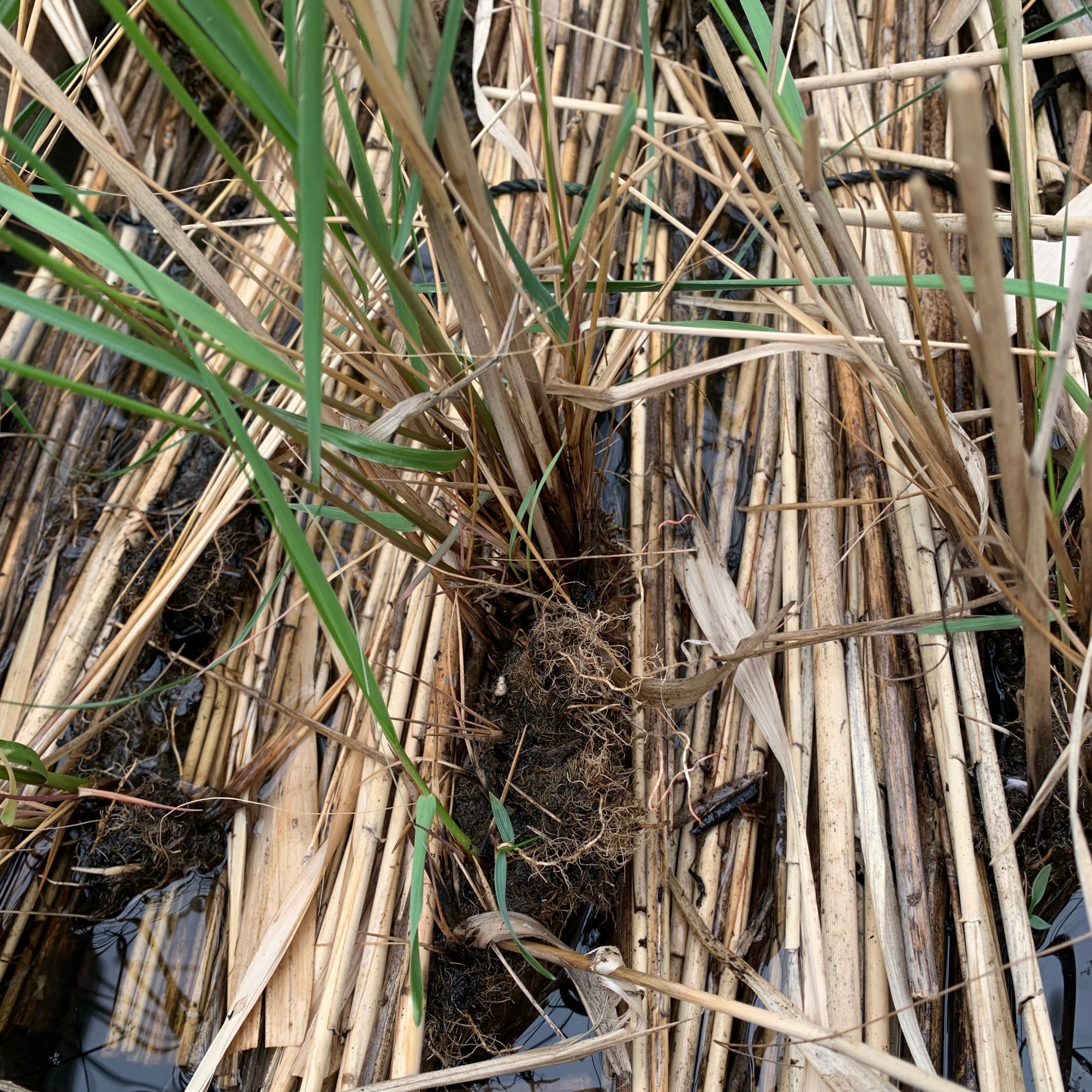
- Woven bundles of Phragmites, with plugs squeezed into the gaps between bundles
- Mixed loose coconut fiber and loose Phragmites fragments, with plugs incorporated
- Burlap pouches containing wood chips and coconut fiber, with plugs inserted through holes in the burlap
- Mixed loose hemp fiber and loose Phragmites fragments, with plugs incorporated
- Plugs surrounded by potting soil (CONTROL)
- Plugs in permeable plastic with no added substrate (CONTROL)
Results
The Spartina alterniflora grew abundantly and rapidly in all of the trials, with dense roots extending outward from the seedlings and binding together the mixed substrate materials. This finding validated our method of planting Spartina plugs into the Phragmites substrates of our floating wetland and living shoreline prototypes. The roots can establish in the reeds, thrive, and quickly establish healthy root systems if the conditions are right. The floating wetlands and living shoreline prototypes that we have deployed outdoors turned into a second phase of this experiment. In the natural environment, away from the controlled greenhouse setting with variable temperatures and water conditions, the growth of Spartina is a lot more fickle. Various environmental conditions add stress to the plants, so a major goal in designing our prototypes is to engineer with a substrate that keeps the vulnerable young seedlings protected and adequately wet so that they can thrive and expand.
Our current research initiative takes this experiment to the next level: we are attempting to grow Spartina using the approaches that proved successful in the greenhouse, but at a larger scale, in a tougher location, and using Spartina alterniflora seeds that we collected locally, rather than using only pre-grown seedlings.

 emerald-tutu.com