
Starting in 2021, we set out to test the efficacy of our proposed floating nature-based infrastructure through numerical modeling, physical network lab tests, and an instrumented full-scale lab prototype. We found that our scheme for a vast network of interconnected floating units would successfully reduce wave energy and could be used to protect a shoreline. But simulations can make errors, so we sought to effectively cross-check our work and remove uncertainty by creating multiple models at several scales—from a single unit to massive networks with thousands of units. We used the results from laboratory tests to inform the numerical properties used in larger network simulations, producing a surprisingly accurate simulated result.

44-unit network wave attenuation study
Study of a 44-unit network of prototypes in a massive wave tank lab facility at Oregon State University Directional Wave Basin, Corvallis, OR

Single-unit wave dispersion study
Study of an individual prototype in a linear wave flume lab facility at Oregon State University Wave Flume, Corvallis, OR
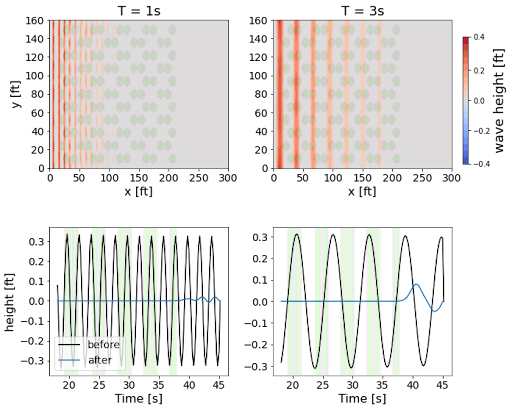
N-unit network surface numerical modeling
Study of massive network aggregate water dynamics using custom numerical fluid surface simulation at Scripps Institution of Oceanography Supercomputer Cluster, La Jolla, CA

Single-unit fluid mechanics numerical modeling
Study of individual unit localized water dynamics using custom numerical fluid particle simulation at Northeastern University CURES Lab, Boston, MA
 emerald-tutu.com