
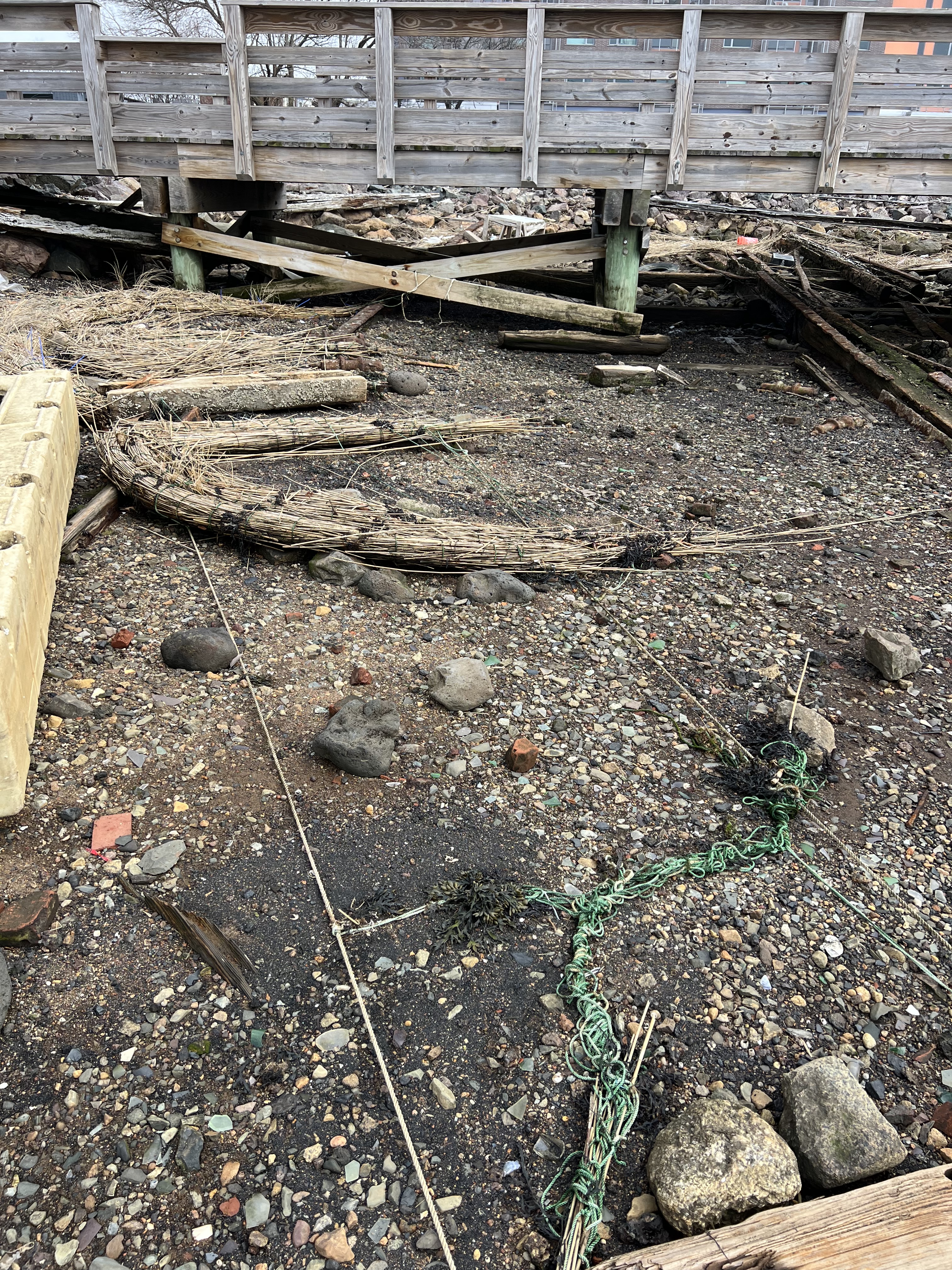
This style of living shoreline starts with bundles of dead Phragmites reeds bound with a simple lashing method using nylon string. Individual bundles are then tied to each other and curved or bent into various shapes for stability. With typically between 3 and 6 individual bundles, the mat-like platform holds the substrate materials flat. This creates a stable substrate of ideal flat conditions for Spartina to thrive that resists shifting and rolling. We have tested various methods for securing these prototypes to the shore, including pinning them down with stakes and adding heavy rocks on top.


How It’s Made
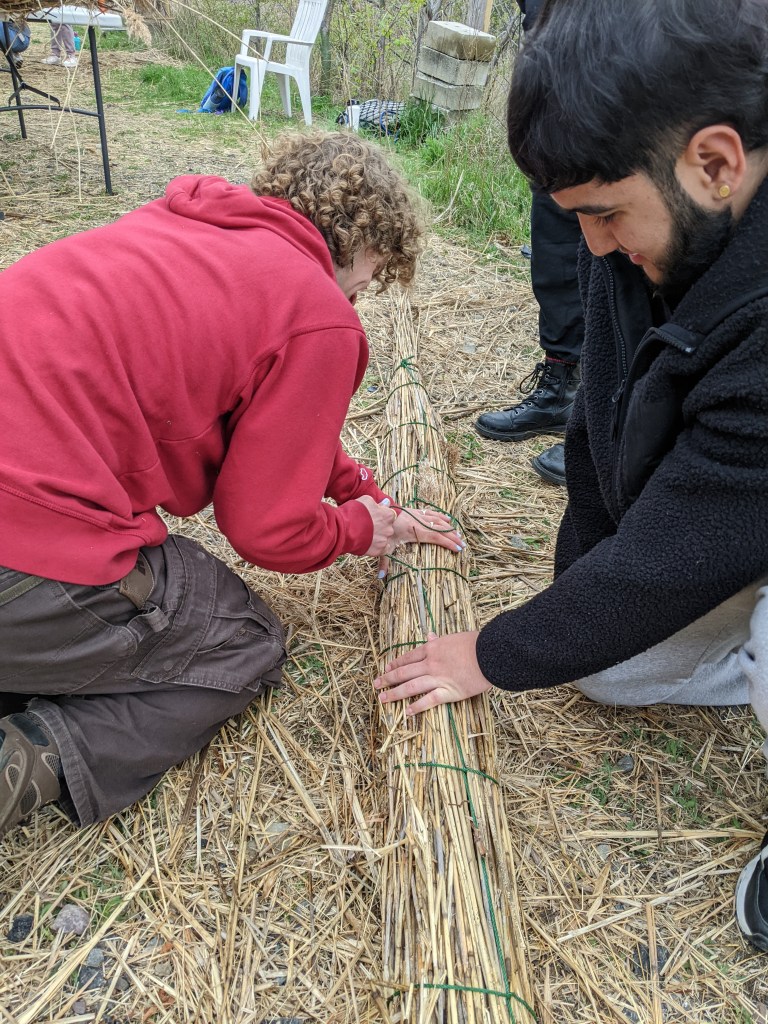
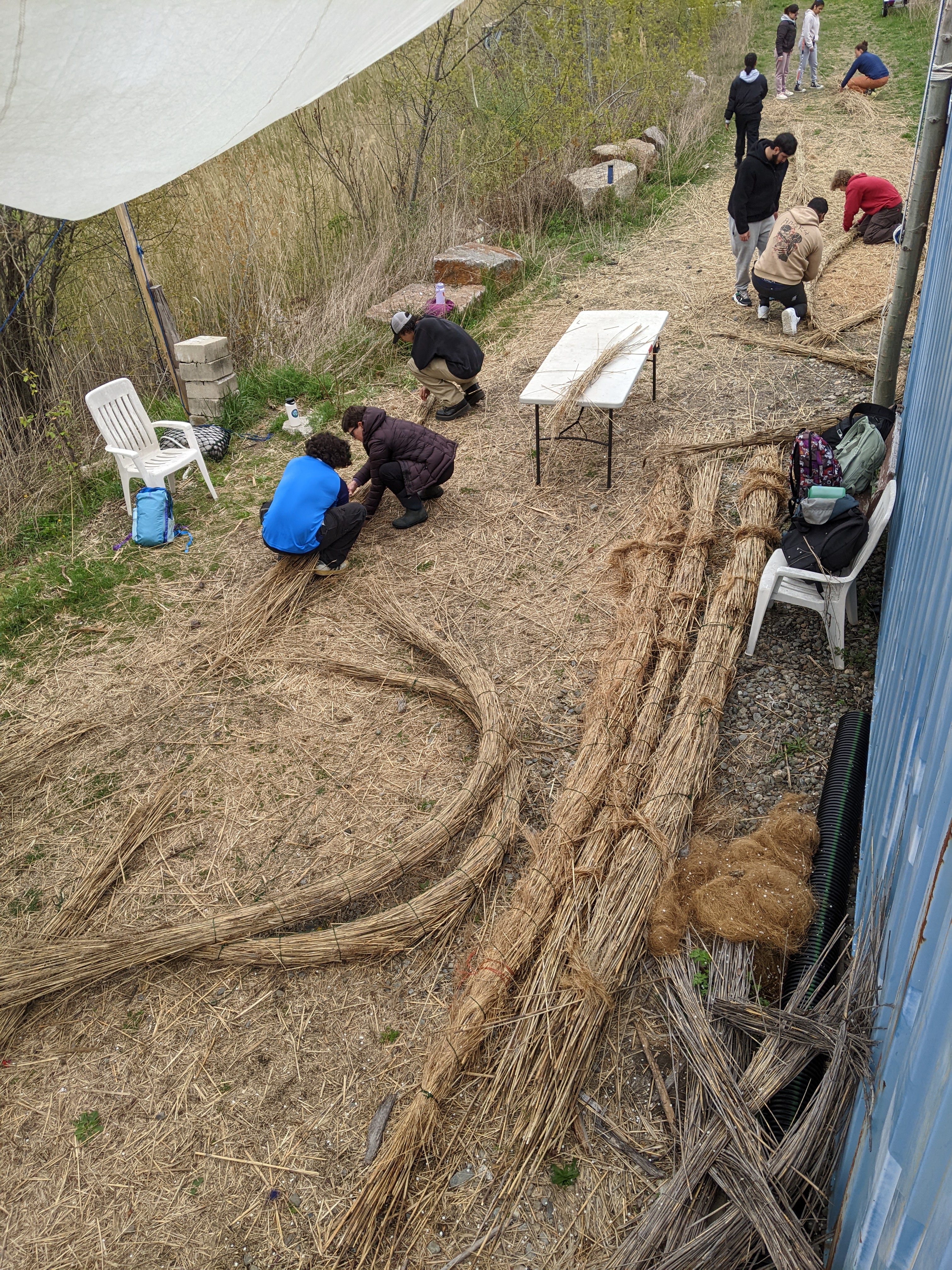
Harvested Phragmites reeds are laid out on the ground in small bundles, about 6” in diameter. Reeds are spread and distributed so that there is always adequate overlap in their length, ensuring a uniform diameter log of material and no inconsistencies where kinks could form. Each bundle is lashed length-wise using nylon string, with half-hitch loops every 8-10 inches. This “running hitch” lashing style holds the reeds together tightly and it only involves tying two knots, one at each of the two ends. Before the final knot is tied, the lashing is sequentially cinched along its length to remove slack and tighten the bundle.
This forms the basic component of these prototypes—the bundle—which can then be combined in various shapes and combinations. Many of these bundles were combined into crescent shapes, which further increases their stability, and potential to trap sediment, on the shoreline. The crescents themselves were often attached together to create larger swaths of biomass coverage on site.




Deployment Locations
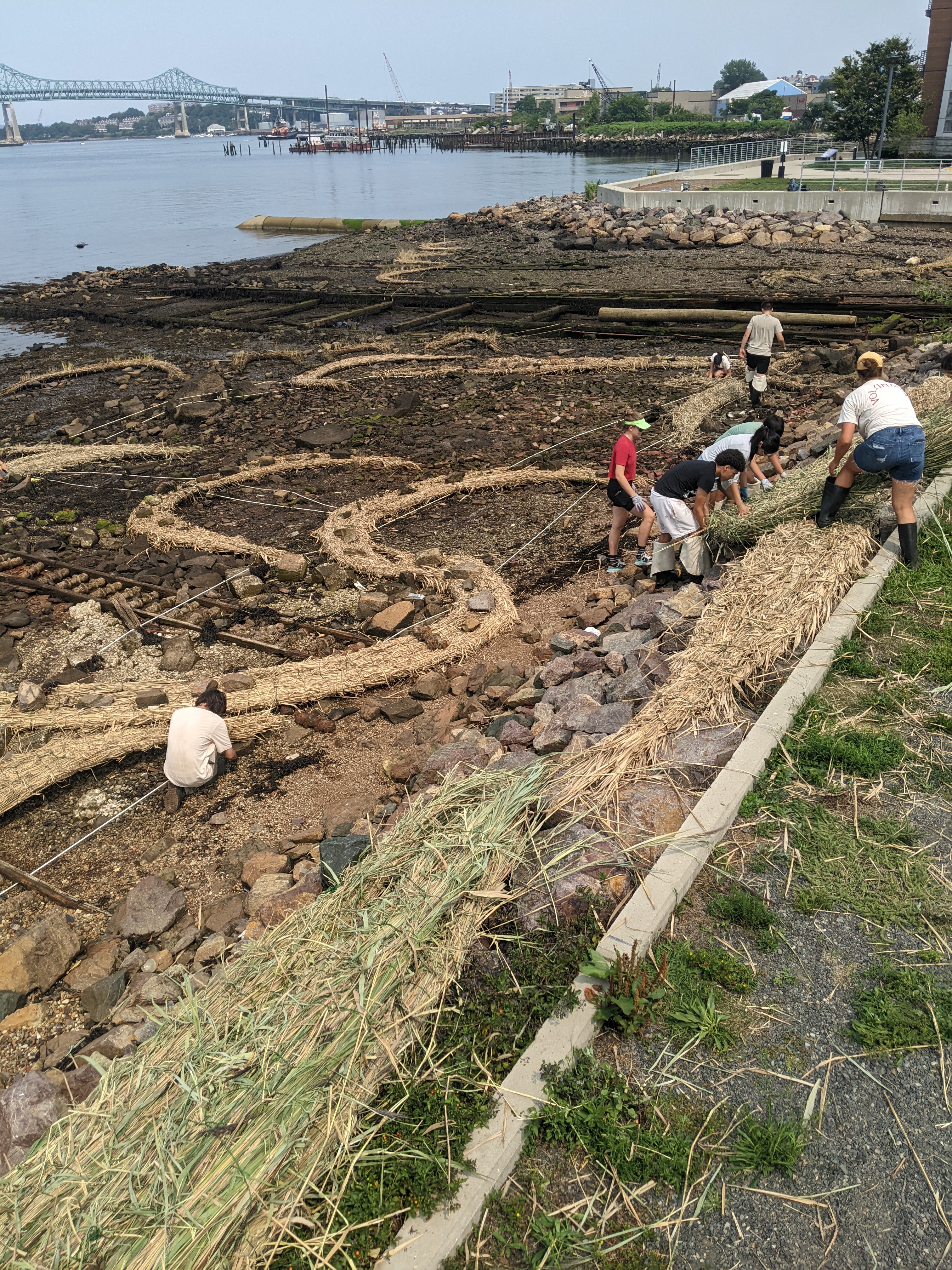
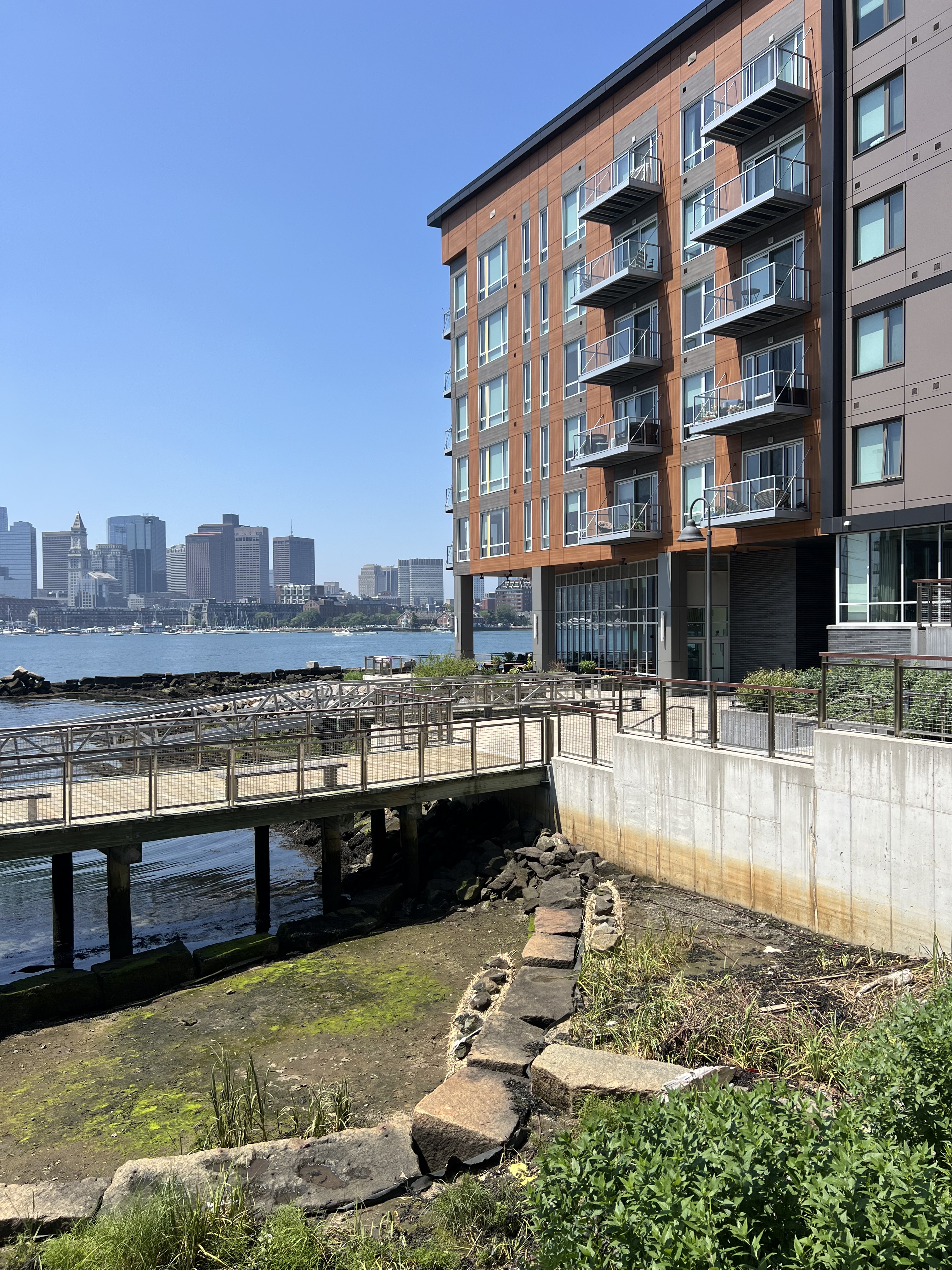
The Emerald Tutu team received permits to use the intertidal area at Border Street Waterfront for the deployment of living shoreline prototypes. Our team of collaborators surveyed the beach to determine an appropriate elevational range, and designed the prototype shapes and sizes with their site layout in mind. We worked around the existing elements on the landscape: large rocks, decrepit wood tracks and metal rails, and other traces of the site’s past life as an industrial ship building and launch facility.
We tied long ropes across the beach area to act as mounting points for the prototypes on an otherwise hard-to-anchor shoreline. We also tested alternative strategies with rocks, bricks, and other found materials to keep the buoyant biomass from floating. We deployed 20 prototypes over the course of 2024, nine crescents, seven canoes, three esses, and one ring.
Our work at Border Street in 2024 allowed us to develop our strategy for fabrication and implementation, allowing for an efficient and seamless deployment at the Clippership Wharfs constructed living shoreline. We deployed five canoe lashed bundle prototypes at various elevations, planting Spartina alterniflora in all of them.

Successes & Failures
Successes:
- These prototypes are flat and tightly bound, and the crevices between bundles are ideal for starting Spartina seedlings. We inserted them with a metal tool to help hold the bundles apart. Seedlings were held securely in place by the tightness of the bundles and their lacing.
- The flat surface is conducive to Spartina growth, providing room for lateral plant expansion over broad flat areas.
- Bending the bundles into different forms and aggregations allowed us to successfully work around the varied existing conditions of the site. This made for a living shoreline module that allows for adaptation to site topography and other situations.
- Integrating found site materials such as bricks, rocks, and cast iron rollers was an effective way to keep prototypes in place.
- The canoe shaped proved to stay intact the longest and strongest throughout the winter, was easy to make, transport, and carry, and became a crowd favorite. This shape was used in a second experiment!
Failures:
- Bending the bundles too tightly sometimes resulted in the Phragmites reeds snapping or kinking at a weak point.
- Securing the prototypes to the intertidal site proved difficult, and a few prototypes shifted around with the tides and loosened despite being affixed in place with rope and stakes. We responded and developed approaches that work, but need to continue to evaluate these methods and study how they perform in various intertidal sites.
- Over the winter ice and snow, the Phragmites began to break out from the bundles, leaving some prototypes to fully fall apart.

 emerald-tutu.com