Prototyping biomass-based mats with pre-grown Spartina alterniflora for a “DIY-able,” deployable living shoreline solution for urban coastlines
The Emerald Tutu team, over the course of 2025, created a nursery system for pre-growing living shoreline mats at our work yard. With our extensive experience growing Spartina alterniflora on our various in-situ living shoreline prototypes since 2023, we saw the opportunity for a new approach that accomplishes a few specific objectives not possible in the field, and hopefully can be a low-tech “DIY-able” deployable solution that many coastal stewards can do themselves to re-green their local shorelines.
Why this approach works, and why it’s unique
This table lists some of the pros and cons of the two different strategies for marsh restoration mat units. We have built many in-situ prototypes over the last several years, and we wanted to attempt an alternative nursery-style strategy based on these fundamental aspects of the biomass materials and the species of marsh grass plant.
| MARSH MAT GROWING IN SITU AT INTERTIDAL SITE | MARSH MAT GROWING IN NURSERY-TYPE TRAY | |
| SUBSTRATE MATERIAL | Materials must be tightly bound together with either burlap layers, coconut fiber net, or nylon lashing to resist the dynamic stresses from the motion of the ocean. Ultimately, plant roots should grow throughout the substrate, but they are very sensitive to movement and are finicky if there is any material shifting | Substrate materials can be loosely mixed and layered into the tray. The stable, calm conditions will encourage full propagation of marsh grass roots. Established rhizome matrix will ultimately hold the substrate together by the time it is deployed |
| SALINITY/TIDE | Water is always salty and subject to tidal cycle | Water is fresh. Salty seawater can be added in controlled quantities to knock back weeds and insects |
| PLANT SOURCE | Must use pre-grown “plugs” (nursery-sourced seedlings) because marsh grass seeds will not germinate in salty seawater | Can use your own seeds and germinate them directly in the substrate, after harvesting native seeds from a natural marsh nearby |
| IRRIGATION SYSTEM | Not needed—the tidal cycle does the trick | Need to keep the substrate wet in its tray, either by manual watering or automatic irrigation |
| BUOYANCY | Need to weigh down bio-based substrate mechanically or use stakes and lashing to affix prototype down. Bio-based materials will be buoyant for 3-6 months in an intertidal site until fully saturated | Need to weigh down bio-based substrate mechanically. Bio-based materials will be buoyant for 1-2 months in a nursery-style tray if they are kept wet until fully saturated |
| TRANSPORTATION | Need to pre-build mat substrate by combining and securing the biomass, then need to transport the dry units to the site. Plants must be added in situ or immediately before transport because they must be kept wet to stay alive | The finished grown marsh mat needs to ultimately be transported to the site to deploy it and kept wet to keep the marsh grass alive. Ideally the nursery trays can be located nearby or directly at the ultimate shoreline deployment site |
The Experiment
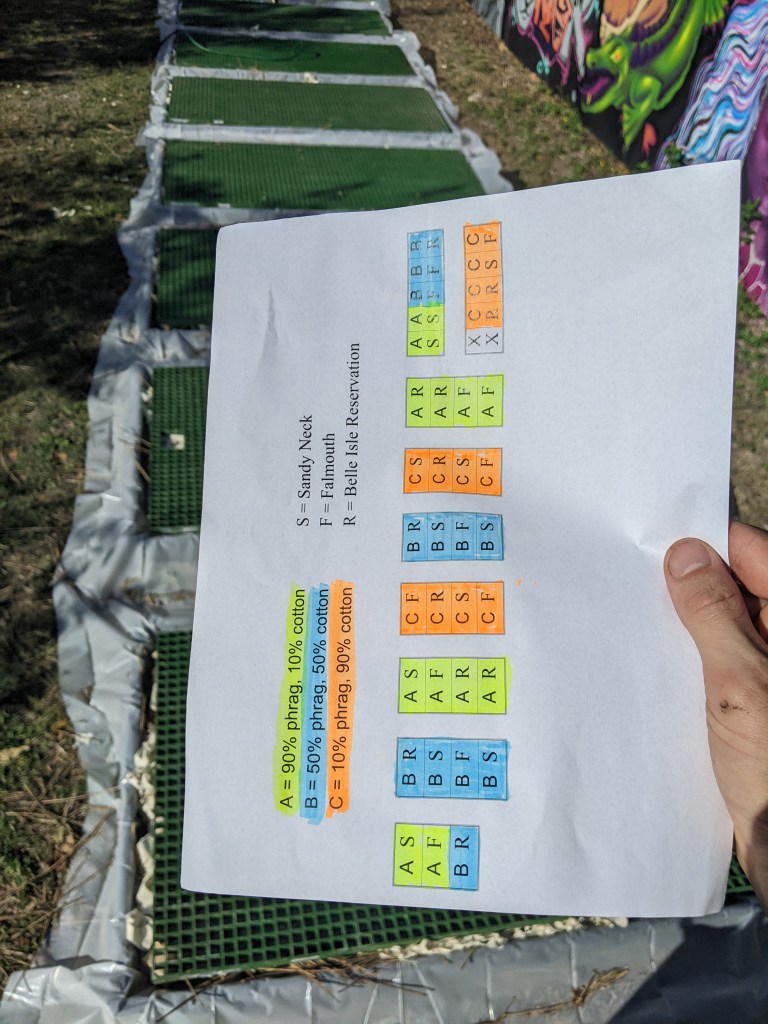
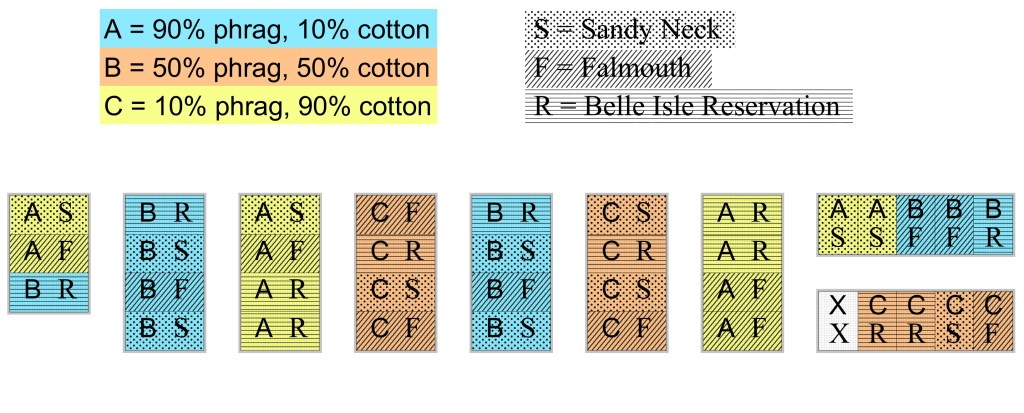
We created nine floodable planting beds, subdivided into 36 separate treatments. We wanted to use the Spartina alterniflora seeds that we had collected, focusing on the three seed source sites that had yielded the best germination results—Sandy Neck, Belle Isle, and Falmouth. We also wanted to test different mixes of two crucial biomaterials, waste cotton fabric and dead Phragmites reeds, at 90%-10%, 50%-50%, and 10%-90%. And we randomized the position of three replicants of each combination to balance out any position-based inconsistencies— 3 X 3 X 3 = 36.
| THE RESEARCH QUESTION: How vigorously do bio-local seed-sprouted Spartina alterniflora plants grow when sewn into mixes of wet biomass in a stable, controlled, irrigated nursery-style flood table? |
The Apparatus
We began with the broader goal of making a simple nursery-style flood table system that was easy to operate—and would be easy for other interested growers to replicate on their own.
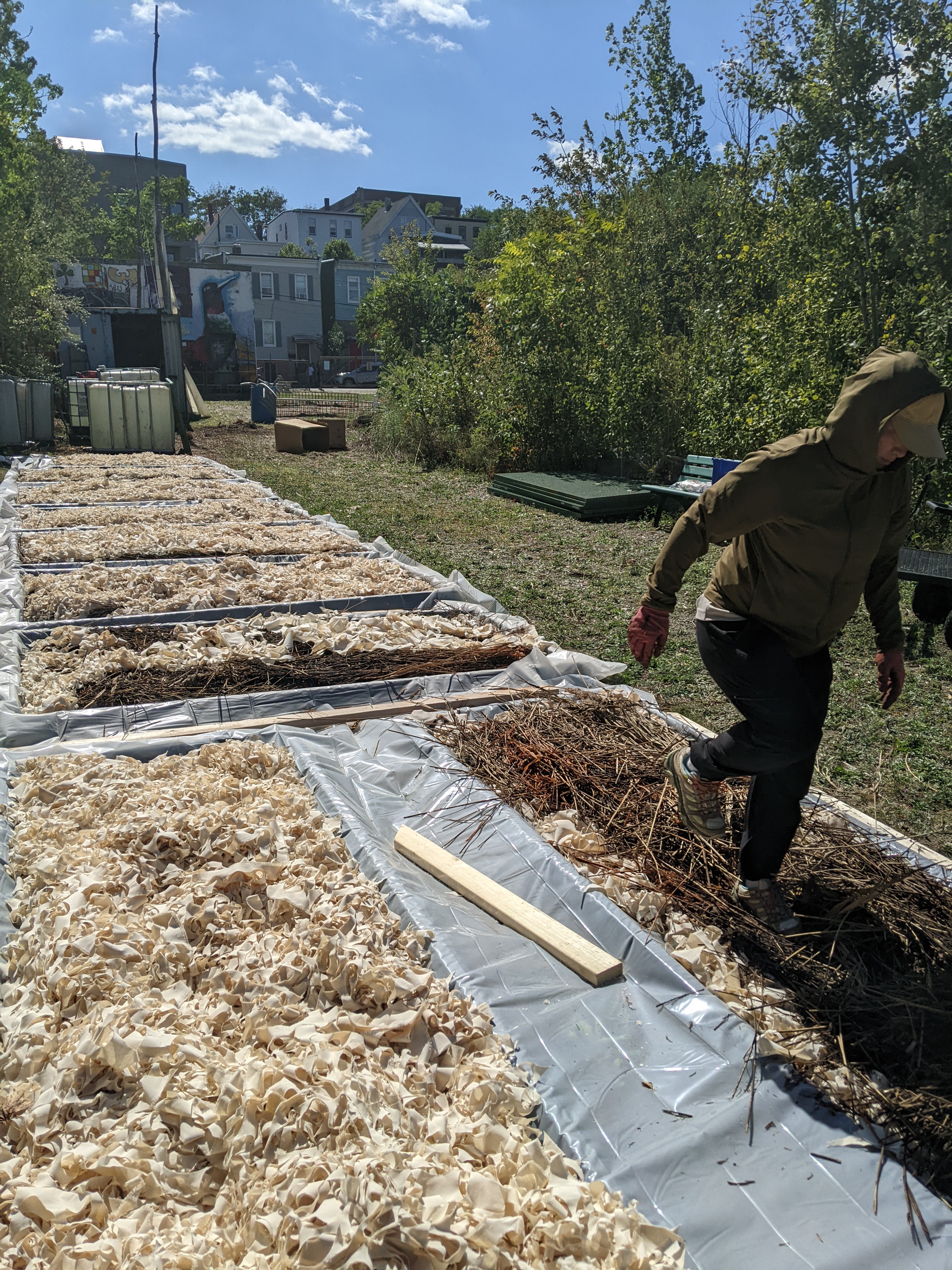
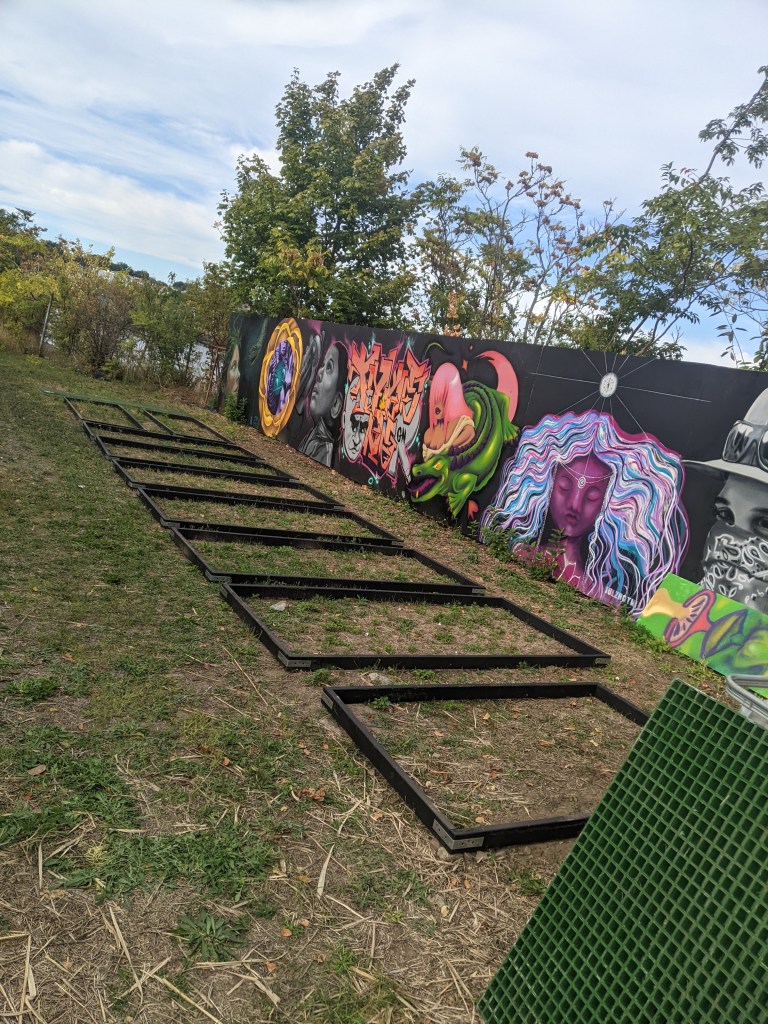
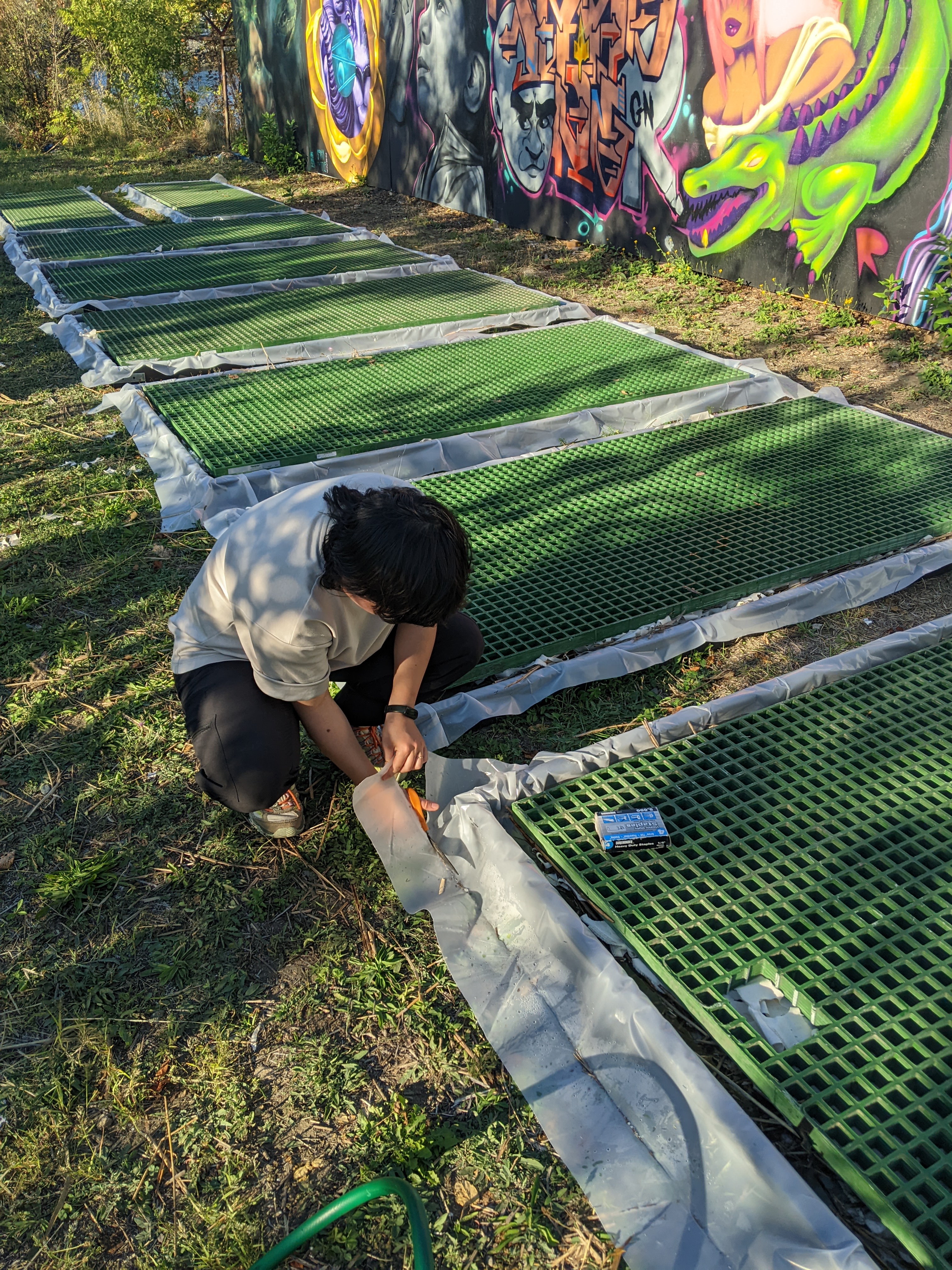
The flood trays were constructed with lumber and leveled in position on the ground, then lined with plastic film. We sized them to accommodate an important part of the experiment: the ballast.
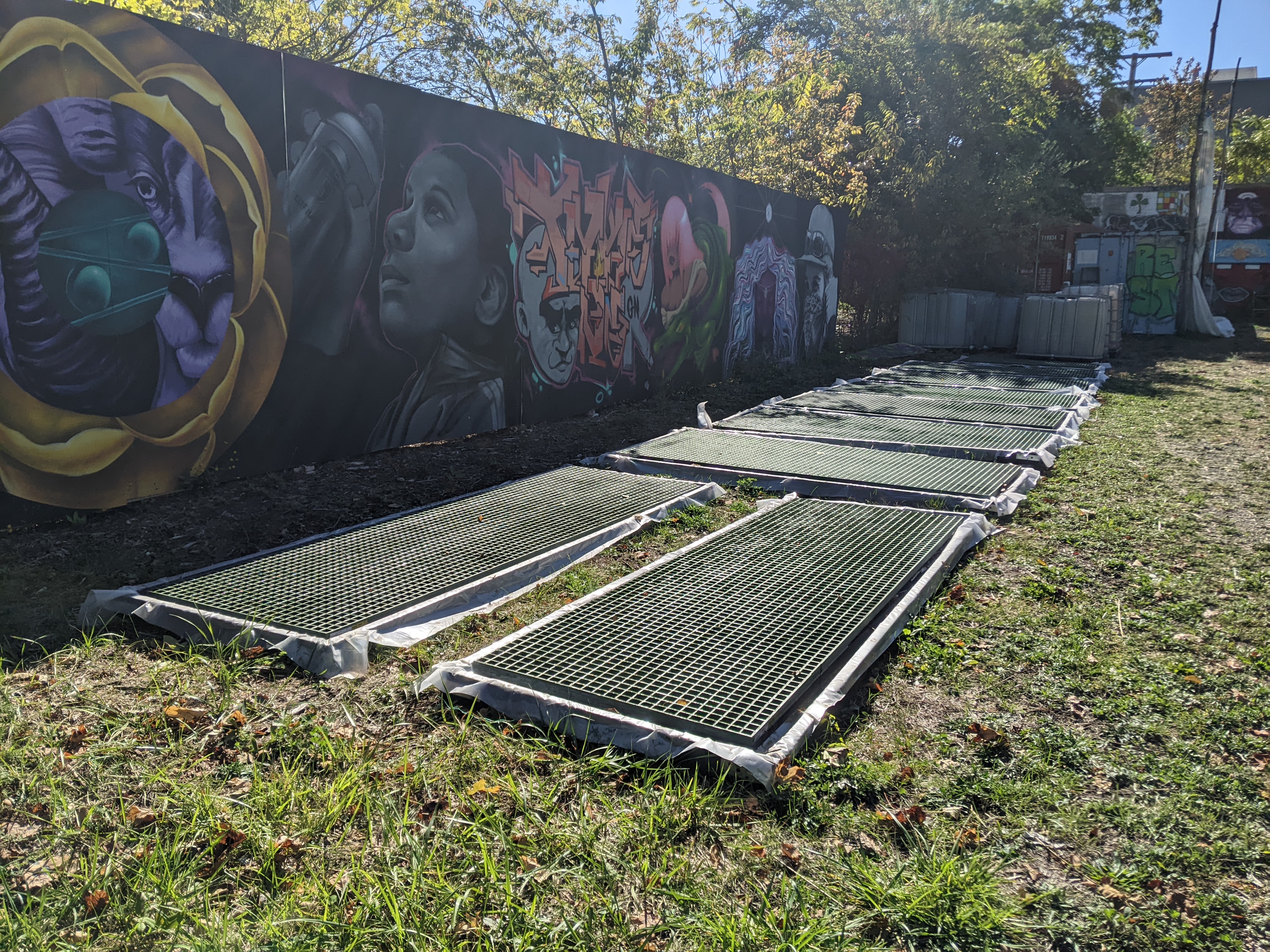
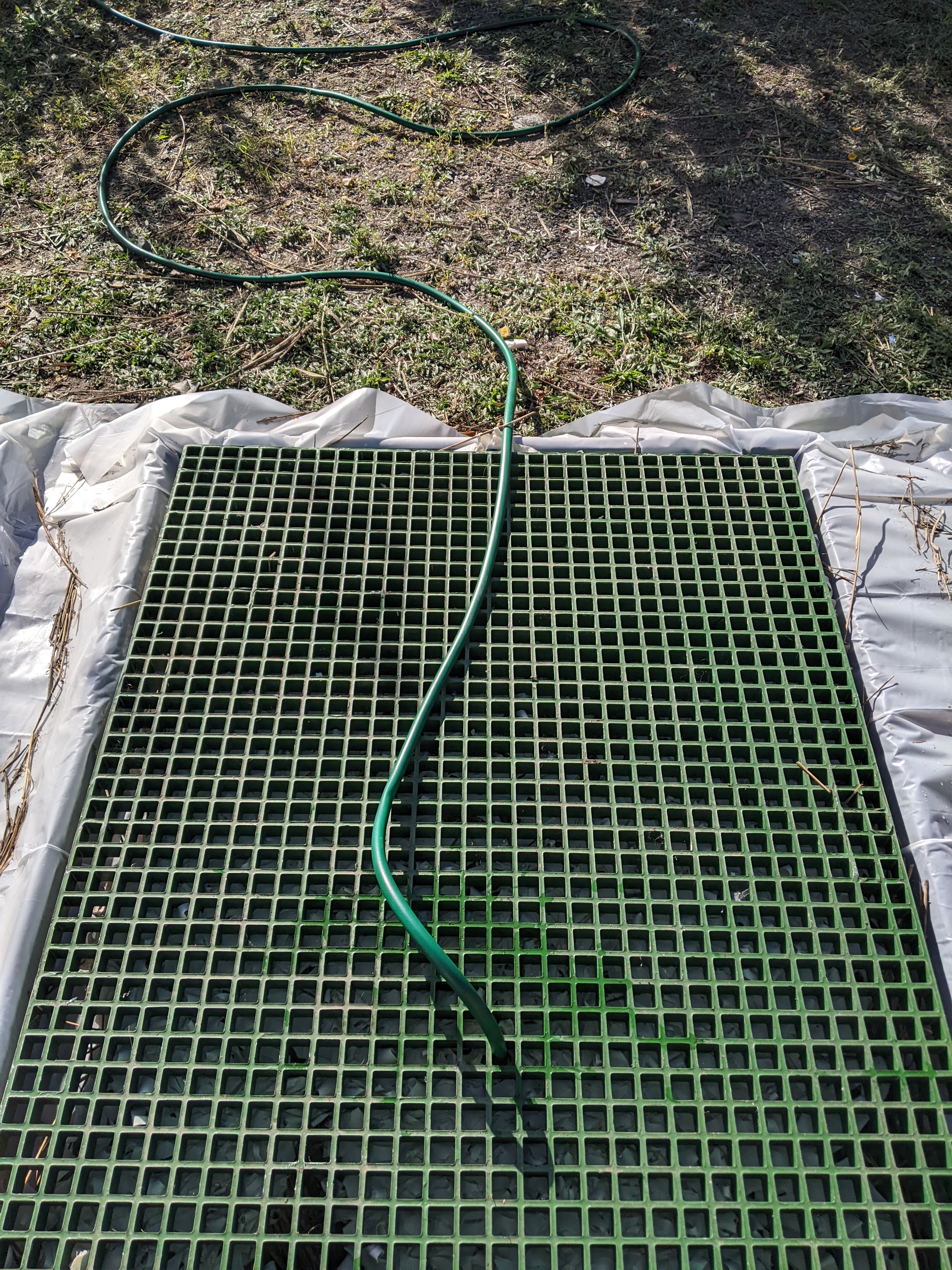
For ballast, we were able to borrow an appropriate material from our local urban farm: fiberglass grate panels. This is a rigid, heavy material that works perfectly to compress the biomass and hold it under the water level within each flood table.
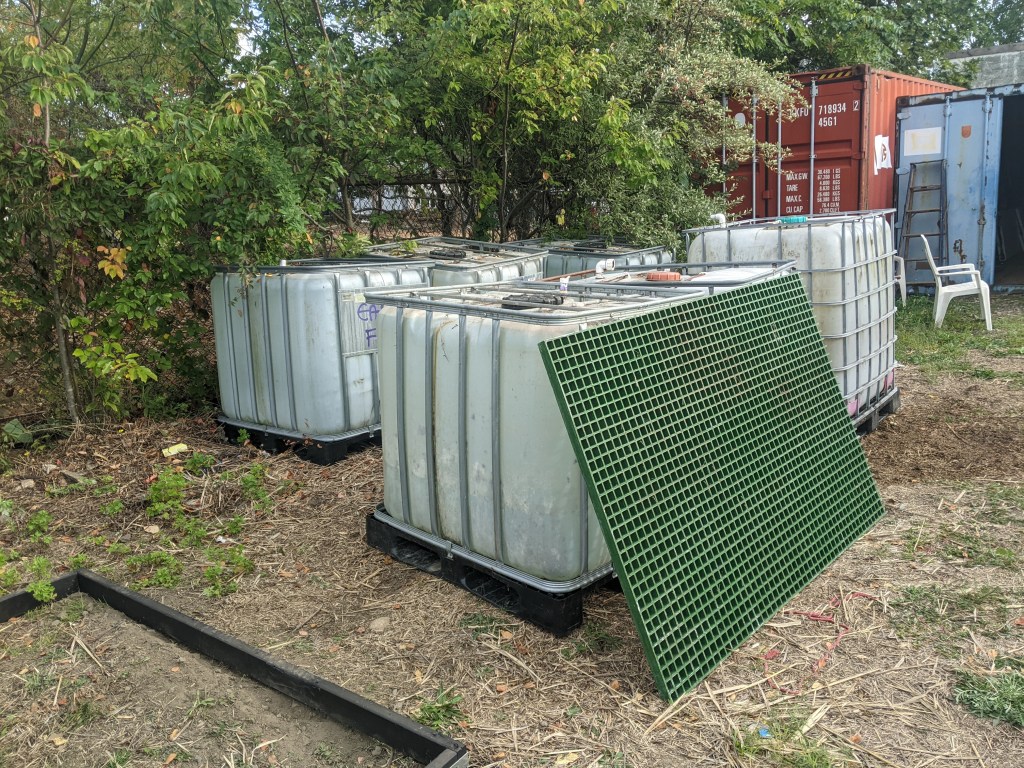
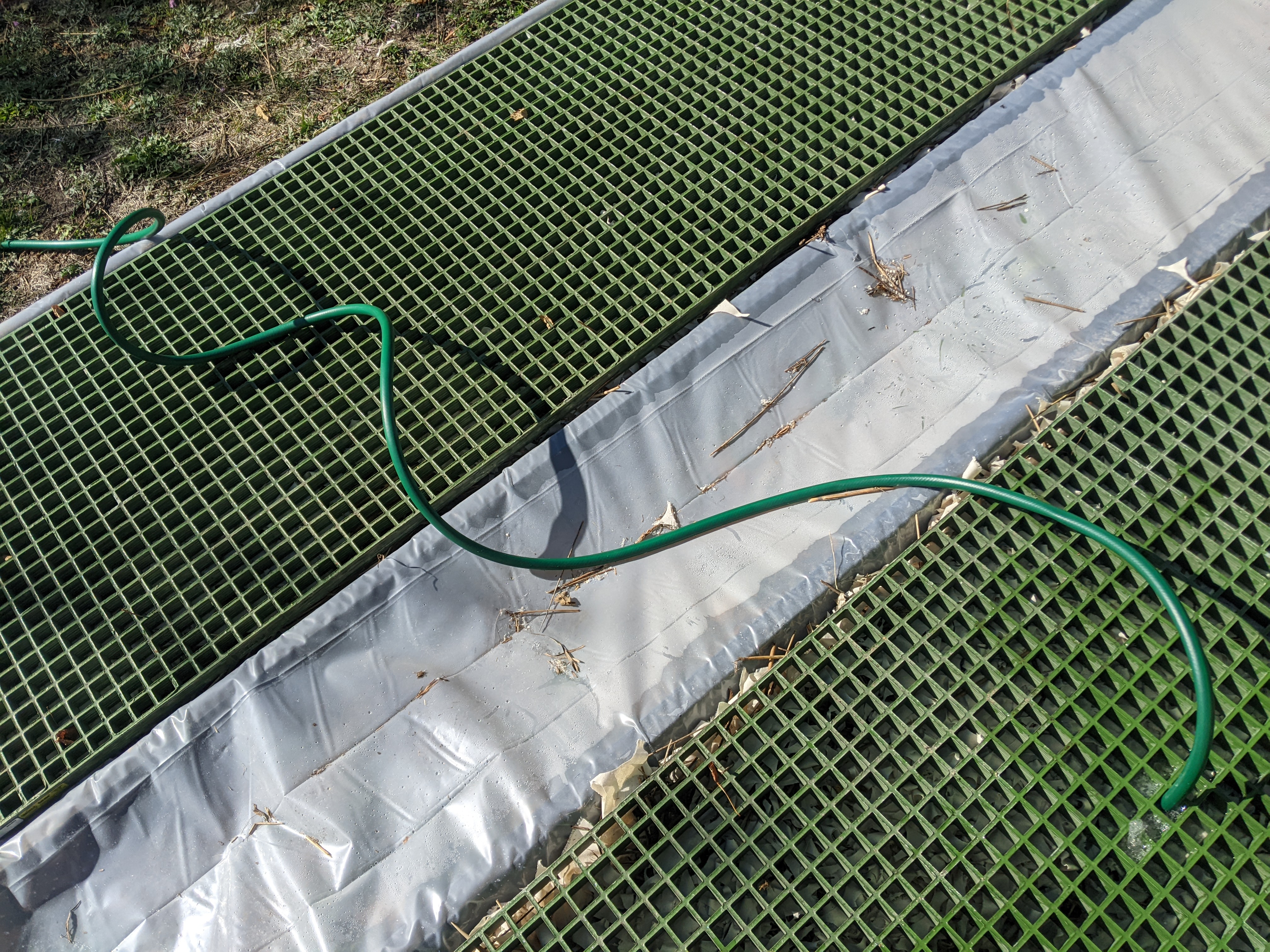
For the irrigation system, we rounded up seven 220-gallon IBC tanks, a standard polypropylene tank unit used in the food and drink industry. These are a familiar sight on farms, where they are used to hold rainwater, maple sap, and any other bulk liquids. Since our work yard is not equipped with running water, we tapped into an adjacent fire hydrant and used a 200-foot fire hose to fill our tanks. From there, a small electric hose pump allowed us to irrigate our frames on a weekly basis—as-needed between rainy days—and keep the biomass fully wet. After 4-6 weeks, the biomass becomes saturated and is no longer buoyant. At that point in time, the grates can be lifted off and removed
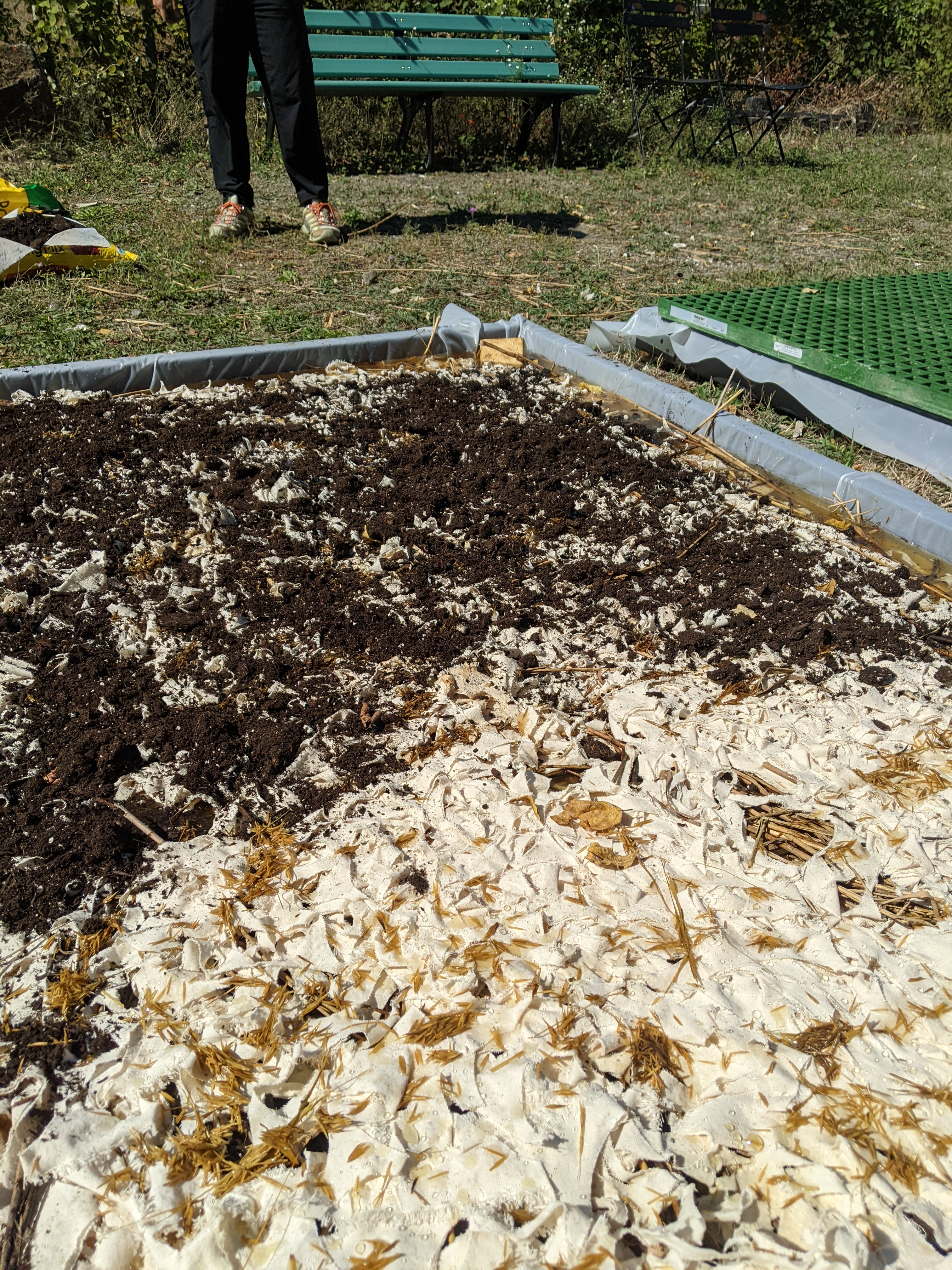
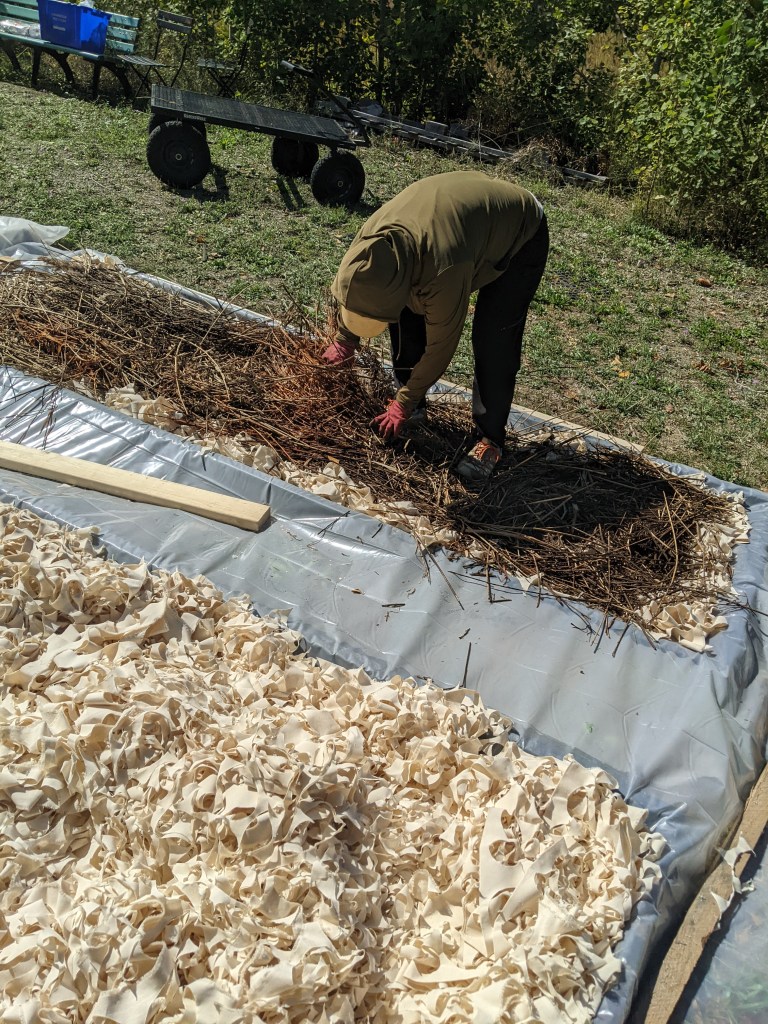
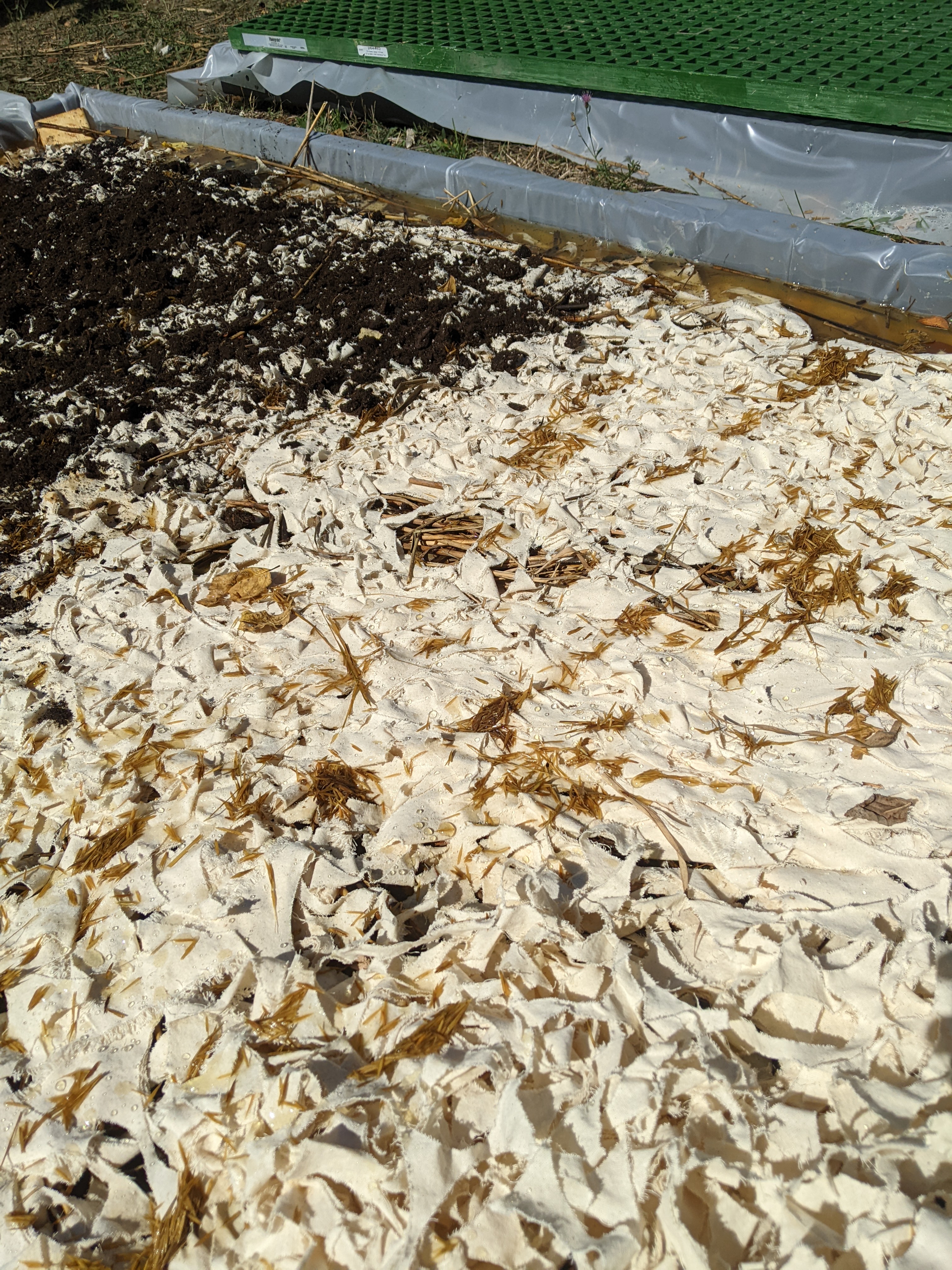
For the substrates, we layered together our desired mixtures of biomaterials, waste cotton fiber and harvested Phragmites reeds. The cotton was sourced from a local textile recycling plant, as an offcut from their fabrication of round disk polisher tools, so it had a regular perforated pattern. Layering these two materials created a tangle, as the sharp reeds stuck into the soft fabric fibers much like velcro. We also layered in about 3 pounds of fertilizer per flood table, which amounted to a light uniform sprinkling, and we distributed ripened seeds from the various source marshes through each of the 36 treatment areas.
Watching them grow
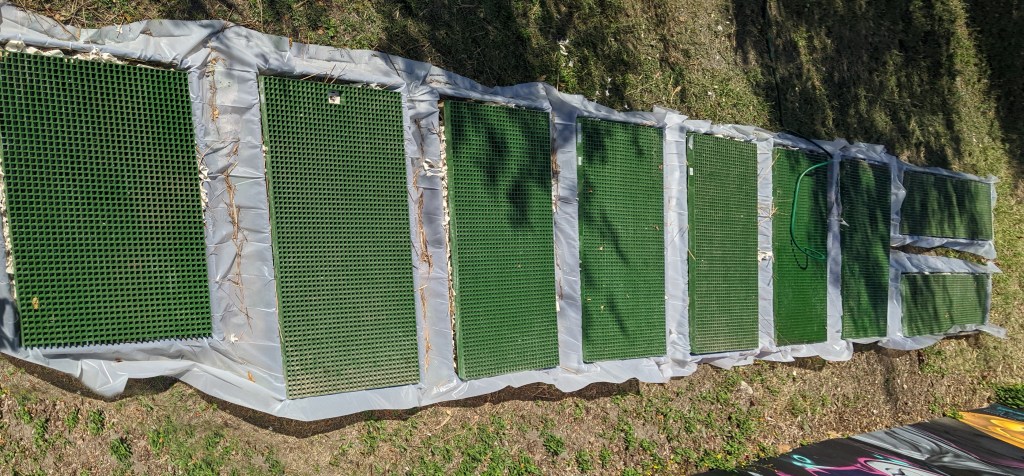
Our previous germination tests with the same spread of seed sources produced incredible results—with only a bit of water in plastic cups and a couple of grow lights, seeds sprouted prolifically, proving the viability of seeds collected directly from marshes and stratified for a few months in a refrigerator. This color-coded and hatch-coded annotated diagram (and corresponding overhead view of the flood trays) shows the layout of our sample treatments, using seeds from Falmouth, Sandy Neck, and Belle Isle. We selected these to focus on because they proved to be the three seed sources with the highest germination rates from previous experiments. Having already proved the viability of our seeds, we prepared to plant them in our irrigated nursery-style flood table and watch them grow…
…Unfortunately, the seeds never sprouted. Untimely funding delays in early 2025 caused our experiment’s timeline to be pushed by 5-6 months. We were able to build our systems and set up the experiment in a matter of weeks in August/September 2025, but by that time the refrigerated seeds had lost their viability. We had collected several gallons of seeds per site, and had treated them carefully with a standard marsh grass laboratory procedure, and gone so far as to confirm their viability in January 2025. Marsh grass seeds are hearty and, if viable, they will sprout vigorously with some sunlight and water, but the delay in funding meant that they sat for too long, losing viability.
Monitoring protocols
The overall goal of the experiment was to observe Spartina alterniflora roots and shoots expanding to take over the entire space of the flood tables. Once marsh grass sprouts, it expands very vigorously through lateral rhizomatic growth of small, fiber-like root tendrils. Rather than sending out thicker “runners,” as bamboo or knotweed do, marsh grass sends roots that are smaller and multiple, more like fuzz or filaments. Therefore, our concepts for monitoring were based on evaluating the morphology and health of the root mass. We planned to cut sample “cores” from each treatment at key moments of growth for comparative analysis. We also planned a more general sprout-count tracking procedure using scientific statistical methods to smooth out variations.
Successes & Failures
Successes:
- We were able to propagate local marsh grass plants from seed, harvesting 900,000 seeds from a dozen marsh locations in New England, stratifying them to simulate a mild winter, and then growing them and assessing germination rates.
- We were able to devise and fabricate from scratch a nursery-style flood table and irrigation apparatus to do our experiment.
- We were able to manage the unwieldy and heavy biomass materials (cotton cloth off-cuts, and dead Phragmites reeds) to assemble our substrates effectively and uniformly.
- We were able to identify the correct material needs for the grow method to function, notably the ballast material which proved to be a perfect solution to compact the substrate and hold it under water without becoming “grown into” the tangle of root fibers.
Failures:
- Funding delays caused a timing mismatch between peak seed viability and planting that resulted in experimental failure; the seeds lost their viability and ultimately did not sprout. In the future, the ability to plant seeds within the annual spring/early summer window of peak viability will be critically important for successful growth in this nursery system.
This work was funded by the Massachusetts Bays National Estuary Partnership and the Infrastructure Investment and Jobs Act (IIJA)