
This numerical model simulates interactions in a virtual wave flume between regular wave conditions and a full-scale floating wetland prototype, analogous to the real lab prototype we built at the O.H. Hinsdale Wave Research Facility (OHLWF) at Oregon State University in 2022. We used the computational fluid dynamics model OpenFOAM since it can simulate water in multiple phases (liquid and gas), and can therefore accurately capture the free surface of waves and resolve wave-structure interactions and wave breaking. Through Reynolds-Averaged Navier-Stokes modeling, OpenFOAM is capable of simulating complex, turbulent flows, and capturing wave-structure interactions through energy dissipation calculations.
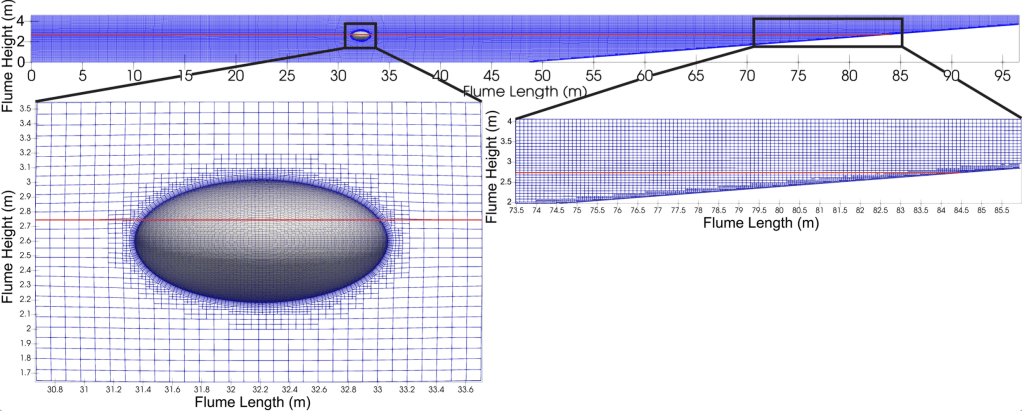
Side view of OHLWF OpenFOAM mesh (top) with blowout view of meshed bare prototype (bottom left) and beach slope (bottom right). The red line denotes the still water level at 2.74 meters.

Measured and modeled water levels at onshore (WG [wave guage]1 and WG2) and offshore (WG3 and WG4) wave gauges for runs testing the bare prototype configuration for (A) 2 second wave period and 0.20 meter wave height, (B) 2 second wave period and 0.30 meter wave height, (C) 3 second wave period and 0.20 meter wave height, and (D) 3 second wave period and 0.30 meter wave height wave conditions.
What we learned
Simulation outputs show that the floating wetland prototype increased wave height attenuation for shorter wave periods and larger wave heights. Similarly, the modeled turbulent kinetic energy increased for shorter wave period and larger wave height simulations. The 3 second, 0.2 m wave produced both the lowest modeled wave height attenuation and turbulent kinetic energy; the 2 second, 0.3 m wave produced the largest modeled wave height attenuation and turbulent kinetic energy. The simulation outputs suggest that as wave period (and wavelength) increases, waves interact less with the floating wetland prototype, and have a lower impact on modeled wave height attenuation and turbulent kinetic energy.
The primary means of wave attenuation is likely due to generated turbulence, from waves hitting the prototype. Since taller waves hold more energy, when they interact with the floating wetland prototype we observe increased turbulent kinetic energy and wave height attenuation.
Overall, the modeled results demonstrate that a single floating unit does indeed reduce wave height amplitude along with turbulent kinetic energy. This experiment allowed us to take a closer look at the dynamics in the immediate vicinity of a single unit to see exactly how the energy is dissipated.

 emerald-tutu.com