
This style of living shoreline uses coconut fiber netting tubes filled with Phragmites reeds as the basic unit. The process for assembly is similar to the Spiral Net Floating Wetland Prototype, using a long plastic sheet to hold the reeds before encapsulating them with the netting. In this prototype, the coconut fiber netting tube is only about 12 feet long, and multiple units are rafted together on site rather than being rolled. These “logs” are akin to the more traditional coir logs commonly used in coastal restoration, but use Phragmites rather than coconut fiber as their inner fill material.


How It’s Made
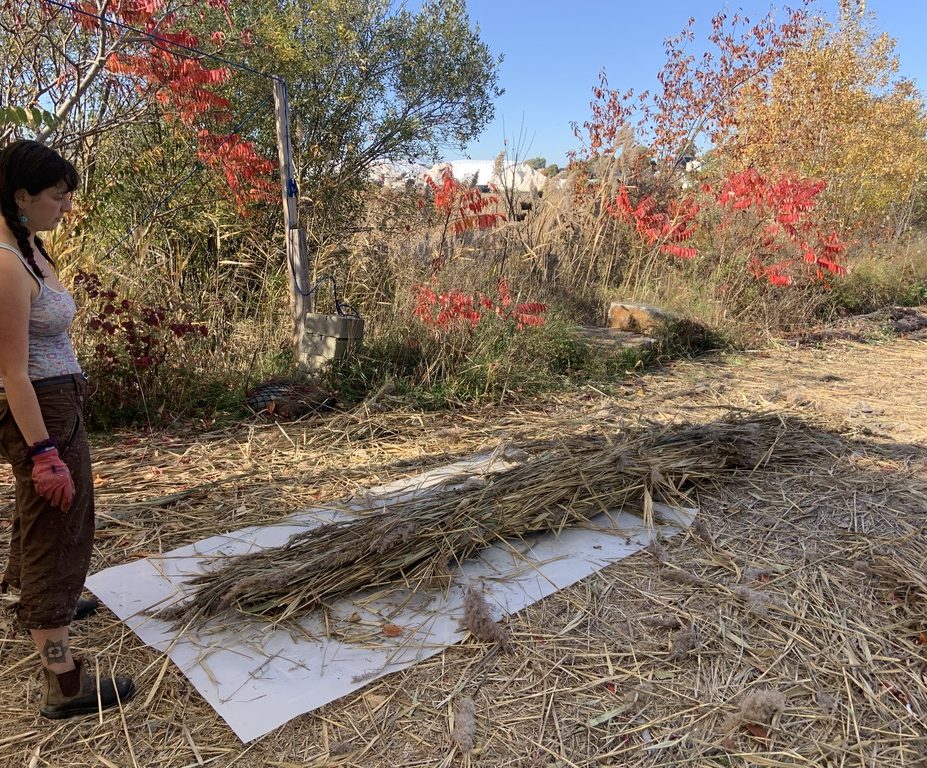
Harvested Phragmites reeds are laid atop a short linear piece of plastic sheeting, taking care to spread and distribute the individual pieces so that there is always adequate overlap in their length. This ensures a uniform diameter log of material, with no inconsistencies or weak points where kinks could form.
The plastic sheet is curled to encapsulate the biomass, and then one coconut fiber netting tube is slid around it. When the plastic sheeting is pulled out, the coconut fiber tube stretches in length to enclose the inner biomass, creating a log of Phragmites encased in coconut fiber netting.
The ends of the tubes are tied together using coconut fiber strings or from nylon string where necessary.. Deployed individually or lashed together on site, the net enclosure allows for the insertion of bricks, rocks, and other found site materials that help keep them in place on the shore.
Deployment Locations
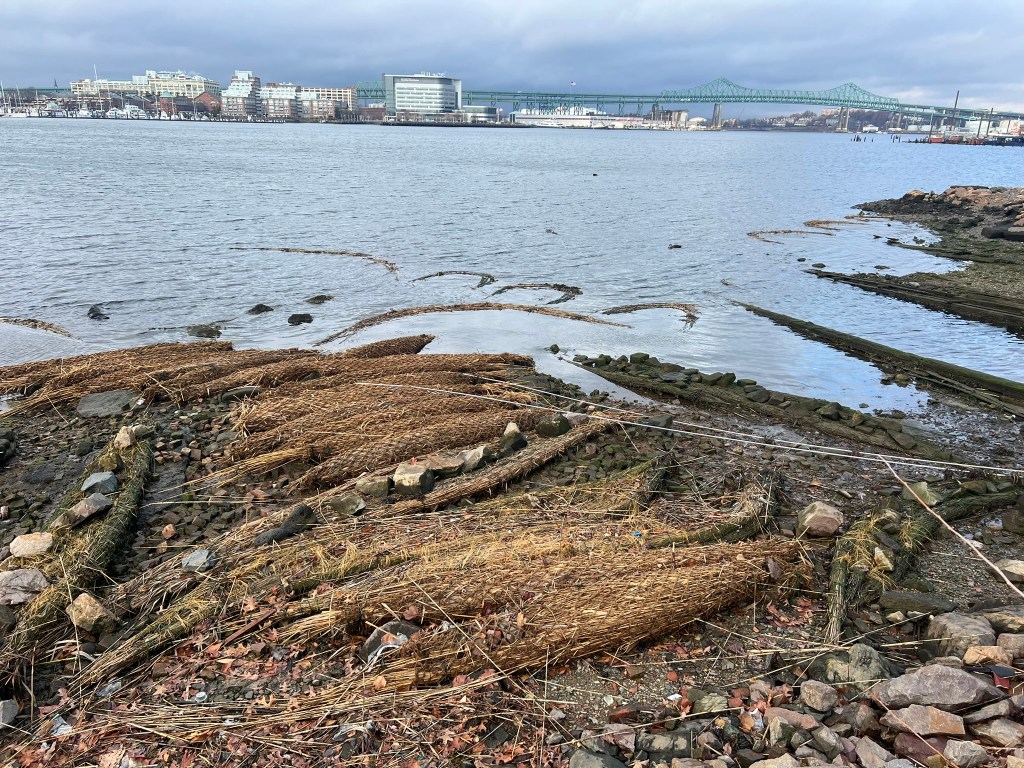
These units were deployed at the Border Street Waterfront and at the Lynnway South Bulkhead. At the Boston site, paving bricks left over from the former industrial use of the beach—unique to a post-industrial shoreline—were inserted into the net tubes to keep the biomass from floating or moving. A row of inserted bricks placed into the bottom of the net provided enough weight and stability to prevent them from floating or shifting during high tides. This problem is especially pronounced when the prototypes are initially launched, because they are dry and buoyant for several months before they are fully saturated.
At the Lynn site, there was no heavy material onsite to use for anchoring the prototypes to the sediment. Instead, the units were tied to the wood posts and planks of the deteriorating seawall.


Successes & Failures
Successes:
- Using coconut fiber net tubes and the familiar stuffing method made for quick and efficient fabrication. The net was easier to handle and required less fine fingerwork than lashing bundles.
- The individual logs are a simple shape, and they are all uniform, enabling them to be easily aggregated together to cover a large, flat area of a shoreline site.
Failures:
- The larger log shape makes it more difficult to fit them together over more complex, rough or rocky areas.
- The rounded log shapes, when assembled side-by-side, create an uneven ribbed surface that is not ideal for Spartina growth.
- The rounded log shapes are more likely to roll or shift by rotation, which could disturb plant growth.
- The ends of the coconut fiber needed to be tied tightly to avoid Phragmites from coming out the sides of the coconut fiber net.
- Over the winter the Phragmites began to fall out of the prototypes, leaving only the coconut fiber net behind.


 emerald-tutu.com